sj sj |
||

|
||
Tahitian uke

|
|
|
|||||||
|
Tahitian uke |
Share Thread
|
||||||
|
Subject: RE: Tahitian uke From: GUEST,josepp Date: 19 Sep 11 - 12:20 PM #4 was actually carved in Chicago. This guy has made four of them from what the website said. I imagine that if we pooled our gross annual earnings together, we might have enough for a down payment. I suppose he must be a skilled woodworker who went to the South Seas and saw the carvings on the Tahitian ukes and got an idea for making his own or maybe he was apprenticed by some uke-maker there. The ones from the Marquesas are exceptionally lovely. I wouldn't mind getting one but I'll settle for a plain one. The others are gorgeous but too rich for my blood...or my wallet. |
|
Subject: RE: Tahitian uke From: Roger the Skiffler Date: 19 Sep 11 - 06:38 AM When I was in the Cook Islands in 1993, at least one of the locals played a coconut shell uke. ie a neck attached to a coconut shell body. It sounded like a conventional uke. Tourist shops also sold similar but they looked mored decorative than playable. I love Polynesian carving. Uke no 4 on josepp's link looks beautiful. RtS |
|
Subject: RE: Tahitian uke From: GUEST,josepp Date: 18 Sep 11 - 09:22 PM The sources I've checked say that ukulele means "the gift that came here." |
|
Subject: RE: Tahitian uke From: Stringsinger Date: 18 Sep 11 - 05:00 PM Almost any good guitarist can get around pretty well on a uke. Getting some of those Tahitian rhythms is another thing, though. The Tahitian Uke seems to be tuned with the first string dropped an octave from the conventional Uke C,G,E and the A an octave lower. I would imagine that there are different tunings for this instrument. "The Uke's predecessor comes from Portugal and is sometimes called the "Machete de Braga". The Jumping Flea. The Portugese brought their 4 stringed guitar or 'Machete de Braga' to Hawaii in 1879, when they emigrated to work in the sugar industry. The Hawaiians were impressed with the speed these musicians' fingers flew on the fingerboard, they dubbed the instrument 'ukulele' or jumping flea. With the support of musical monarchs King Kalaukaua and Queen Lilioukalani, this tiny cross between a guitar and a banjo with its sweet sound and ease of mastering was soon adopted as the National Instrument of Hawaii. Later it spread to the United States and eventually to the world. Today the Ukulele is enjoying a renewed popularity with Uke Festivals held in many states and countries" "Warren Buffett: Yes, in between counting $ & making pronouncements on the economy, billionaire Buffett really does play the uke. At least he wouldn't have any problem buying as many as he wants." Now that's rich! |
|
Subject: RE: Tahitian uke From: Stringsinger Date: 18 Sep 11 - 04:40 PM Here's how it sounds http://www.youtube.com/watch?v=UQF7FVdUT2Q&feature=related Great rhythmic instrument. Wow! |
|
Subject: RE: Tahitian uke From: Stringsinger Date: 18 Sep 11 - 04:30 PM How is it tuned? Is it on YouTube? |
|
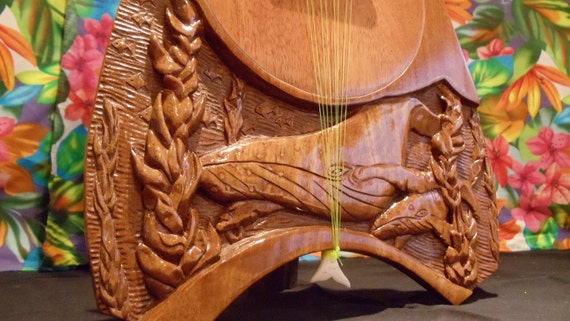
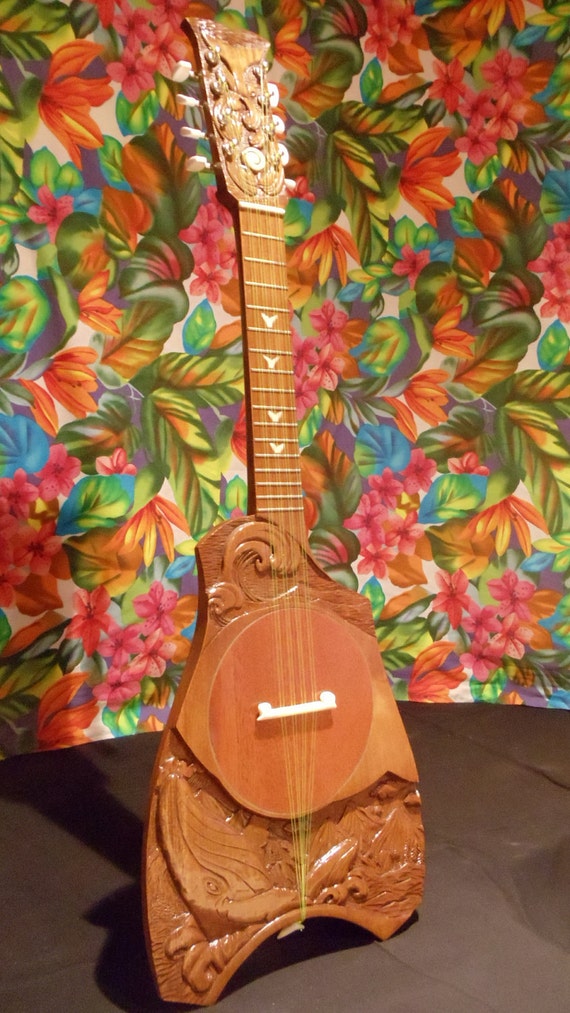
Subject: Tahitian uke From: GUEST,josepp Date: 18 Sep 11 - 02:10 PM The Tahitian ukulele is carved from a single piece of wood (often salusalu or poplar) lightly varnished, has four courses (i.e. eight paired strings) and is strung with 30-lb fishing line. Tuned to the same notes as the older Hawaiian uke, the Tahitian uke's two middle courses are tuned an octave higher than the Hawaiian. Also the Tahitian uke is not hollow but has a conical or tapered hole bored through the body—covered in front with what appears to be a thin circle of wood acting as a diaphragm and bridge-mount. The smaller hole in the back remains open. The sound is thinner and more banjo-like than a Hawaiian uke and generally strummed faster for a sound that is distinctly Tahitian. This very lovely instrument is sometimes called a Tahitian banjo. Like Hawaiian ukes, these too are often fitted with electronics for amplification. Tahitian uke 1 Tahitian uke 2 Tahitian uke 3 Tahitian uke 4 Tahitian uke 4 |
| Share Thread: |