sj sj |
||

|
||
BS: Fun with music theory

|
|
|
Subject: BS: Fun with music theory From: josepp Date: 03 Dec 10 - 08:24 PM I'm sure you've heard of the Fibonacci Sequence where we take two numbers and them together to get the next number in the sequence and then take that sun and larger of the two we added together to get the next number and so on. The sequence looks like this: 1,1,2,3,5,8,13,21,34,55,89,144, etc. The closer to infinity we go, the closer any two adjecent numbers will divide out to 0.618 (or phi) or 1.618 (or Phi). Phi represents the the most economical packing that nature has to offer and it turns up in countless ways. You've heard of the Golden Mean, the Golden Section, the Golden Spiral, etc. All based on phi. One odd thing is that the 11th term in the sequence, 89, has a reciprocal of 0.11235955...which is a close but slightly distorted Fibonacci Sequence which the ancients used to demonstrate macrocosm and microcosm. The macrocosm is contained within the microcosm but imperfectly--the holographic universe where every part contains the whole but, like a holograph, the smaller the microcosm, the more distorted image it contains of the macrocosm. In a musical scale—easiest to see on a keyboard—there are 12 half-steps in an octave which consists of 8 notes (white keys) separated by 5 black keys (designated sharps or flats as the case may be) and 8+5=13. The 5 black keys are also separated in a group of 2 and a group of 3! Moreover 3 and 2 form the ratio for the Perfect 5th interval which consists of 5 notes covered in 7 half-steps. A string plucked "open" will play a Perfect 5th higher when shortened by 2/3rds and both notes will be in beautiful harmony. Musical scales also follow phi. The smallest scale is two notes tuned a perfect 5th apart. To be able to complete the octave, we next need five notes—a pentatonic scale. The next scale in the sequence would be the diatonic scale of seven notes. It is obtained by adding the two-note scale and pentatonic scale together. However, we can only play a diatonic scale in one key unless we temper it. When we temper, however, we lose tonic relationships in that scale since the notes are equally spaced apart musically. So we must next add the diatonic and pentatonic scales together to obtain a chromatic scale of twelve notes which enables us to play the diatonic 7-note scale in 12 different keys. What would the next scale be? We would add the chromatic and diatonic scales together to obtain a 19-note scale. Some musicologists have developed such a scale as well as 19-tone instruments. The perfect 5th in this scale however does not sound consonant. So we would have to resort to a 31-note scale but such instruments would be quite difficult to play. But notice the sequence of scale progression: 2, 5, 7, 12, 19, 31, etc. Again, the Fibonacci Sequence. While it is different from the one Fibonacci proposed, the scale progression sequence also has the property where two adjacent numbers in the sequence dividing out to phi the closer the sequence approaches infinity because any sequence that involves adding the last two numbers to obtain the next number in the sequence will produce phi in the manner described. |
|
Subject: RE: BS: Fun with music theory From: josepp Date: 03 Dec 10 - 08:26 PM Musical scales are determined by a musical interval called the perfect 5th. Pythagoras discovered that if one tuned a string to any given note and then shortened that string by a third but keeping the same tension caused that string to play a perfect 5th higher. Likewise lengthening the string by a third caused it to play a perfect 5th lower. The perfect 5th is the basis of all harmony and all music. It is actually a scale in its own right, a 2-note scale. To add more notes to the scale, we simply pile on the perfect 5ths. Western musicologists have always insisted that the full octave be perfect. A string halved exactly plays an octave higher. Conversely, when the string length is doubled, it plays an octave lower. The ear can pick out even tiny variations from the 1:2 ratio and so it is never violated. This octave was divided into 12 parts or half-steps, which are the smallest division of the octave. Two half-steps equaled a whole step the value of which is 9/8. The problem that Pythagoras discovered was that other intervals as perfect 5ths do not fit inside the octave exactly. For example, the major 3rd interval spans three notes in 4 half-steps. Therefore there are three major 3rd intervals in a 12-half-step octave. The value of a major third is closest to 5/4 so we raise 5/4 by the power of 3 which is 1.953125. Very close to the octave value of 2/1 but not quite and the ear can hear that variation. So the major thirds must be stretched a little to fill the octave exactly. Since there are 6 whole steps in an octave then 9/8 raised to the power of 6 should equal exactly 2. It does not. The value is 2.02728653. Again, the difference is very small but very noticeable. The reason this happens is that fundamental building blocks of the octave—the half-steps—are not exact. They have an arbitrary value of 16/15 but actually vary slightly from one note to the next. So we must stretch or shrink our other intervals to make them fit exactly within an octave. This process is called tempering. |
|
Subject: RE: BS: Fun with music theory From: josepp Date: 03 Dec 10 - 08:28 PM Astronomers of the past believed that music and astronomy were intimately related if not outright the same thing. Going back to Nicomachus in his 3rd century work, Manual of Harmonics, this idea has been around in one form or other for a very long time all over the world. The music of the spheres was a very popular concept. Basically, astronomers of past eras believed that the planets "sang" as they orbited. After all, all moving or spinning bodies can produce a tone so why not a spinning planet swinging continuously around the sun? According to Nicomachus, the Greeks had each planet represented by a musical note. The pitches fell the higher up the celestial ladder one went. The celestial ladder from nearest to farthest was conceived of as Luna, Mercury, Venus, Sol, Mars, Jupiter and Saturn. So Luna had the highest pitch and Saturn the lowest. But shouldn't Saturn be the highest since it is at the top of the ladder? According Nicomachus, the Greeks saw Saturn as being farther from the earth and so if one attached a string from earth to Saturn it would be much longer than the one attached from the earth to Luna. The longer the string, the lower the pitch. This may also explain why Greek scales were descending instead ascending as our modern scales. All the planets together sang in a beautiful harmony. The universe was a symphony. Sounds like old superstitious garbage? The following is a Reuters news article a few years back: WASHINGTON, Sept. 9 — Big black holes sing bass. One particularly monstrous black hole has probably been humming B-flat for billions of years, but at a pitch no human could hear, let alone sing, astronomers said Tuesday. "The intensity of the sound is comparable to human speech," said Andrew Fabian of the Institute of Astronomy at Cambridge, England. But the pitch of the sound is about 57 octaves below the middle C at the middle of a standard piano keyboard. This is far, far deeper than humans can hear, the researchers said, and they believe it is the deepest note ever detected in the universe. The sound is emanating from the Perseus Cluster, a giant clump of galaxies 250 million light-years from Earth. A light-year is about 6 trillion miles (10 trillion kilometers), the distance light travels in a year. Fabian and his colleagues used NASA's orbiting Chandra X-Ray Observatory to investigate X-rays coming from the cluster's heart. Researchers presumed that a supermassive black hole, with perhaps 2.5 billion times the mass of our sun, lay there, and the activity around the center bolstered this assumption. |
|
Subject: RE: BS: Fun with music theory From: olddude Date: 03 Dec 10 - 08:29 PM Lucas variation on Fundamental identity connecting three adjacent Fibonacci numbers. My best explanation is here http://www.goldenmuseum.com/0207Variations_engl.html |
|
Subject: RE: BS: Fun with music theory From: josepp Date: 03 Dec 10 - 08:29 PM Johannes Kepler took things a bit further. He assigned musical intervals to the five astrological configurations called aspects. For instance, the interval called the perfect 4th spans 4 notes—say, C D E F—and does so in 5 half-steps (C-sharp, D, D-sharp, E and F). If one were to shorten the C string to 3/4, it would play at F, a perfect 4th higher. Likewise, if the C string were lengthened to 4/3, it would play a perfect 4th lower (which would be G in this case). One can also divide the frequency of C by the frequency of F and get a 3/4 ratio. So we say the perfect 4th is represented by the ratio of 3:4 or 4:3. In astrology, there is a planetary aspect called a square when two planets are 90 degrees from one another using the sun as the focus. So 3/4 of the circular orbit is left over and so Kepler equated the astrological square with the perfect 4th. The superior conjunction or opposition occurs when two planets are in line on opposite sides of the sun which leaves half the circular orbit which corresponds to the octave higher which is half the frequency of the octave lower and is represented by the ratio of 1:2 or 2:1. The musical interval called the prime, which spans no notes in no half-steps, corresponds to the aspect called a conjunction (or inferior conjunction) when both planets are in line on the same side of the sun leaving the entire circle. The aspect called the sextile, when two planets are 60 degrees apart (leaving 5/6 of the circle), corresponds the minor 3rd interval which has a value of 5:6. The aspect called the trine, when two planets are 120 degrees apart leaves 2/3 of the circle and so corresponds to the perfect 5th interval of 2:3. Kepler also went on to define more aspects of his own invention and corresponded them to various harmonious intervals. |
|
Subject: RE: BS: Fun with music theory From: josepp Date: 03 Dec 10 - 08:30 PM But Kepler also decided to track the movements of each planet's orbit and form ratios using the same period of other planets. For instance, Kepler tracked how far Jupiter moved per day as it rounded the sun at perigee (when the planet is closest to the sun and actually speeds up) and divided this value by the same movement of, say, Venus. To his astonishment, the ratio was nearly a perfect musical interval of some sort. Then he would try tracking one planet at perigee and divide it by another at apogee (when the planet is farthest away from the sun and moving slower) and found, again, the ratio formed a shockingly close approximation of a musical interval. When astronomers tried this using precise modern data measured by computers, they found to their astonishment that the ratios were even closer to the musical intervals than Kepler's less precise data. |
|
Subject: RE: BS: Fun with music theory From: josepp Date: 03 Dec 10 - 08:39 PM Quantum theory came out of the work of Louis de Broglie who discovered that the electron shells around an atom are structured like a musical note with a fundamental frequency accompanied by harmonics or overtones. Perhaps that was why all Pythagorean initiates had to master the lyre (as did the druids). In Greek mythology, the Fates produced the 5 notes or vowels of the lyre but Apollo added 2 more to make a diatonic scale. Pythagoras (whose name means ¡°Apollo speaking¡±) was said to have added an 8th, which completes the octave. The Greeks did not use our 12-tone equal-tempered (or 12-TET) scale of today. A Chinese musicologist of the 16th century, Zhu Zaiyu, first calculated the value of an equal-tempered half-step to be the 12th root of 2 or about 1.0595. Shockingly enough, the name of Apollo in Greek, Apollon, adds up in Greek isopsephia (where every letter in the alphabet has a corresponding number) to 1061. One of his titles, Pythias, from whence "Pythagoras" is derived, adds up to 1059. And Apollo, let us remember, was the god of music. Apollon is Thrice-Great Hermes or Hermes Trismegistus¡ªwho gave us music among other things. In isopsephia, Hermes¡¯ name adds up to 353, which totals to 1059 when multiplied by 3--Thrice-Great Hermes. His name multiplied by 2 totals out to 706 which is very close to 0.707 which is the inverse of the Logos--¡Ì2 (1.414)--and also half of it. 706/1059=2/3=the perfect 5th. In Greek mythology, Hermes invented the lyre and presented as a gift to Apollo, his older brother. Some might determine that the Greeks must have known the about 12-TET since that seems far too close to be coincidence, yet in the 19th century, a Western musicologist developed a system that enabled values between two intervals to be converted into a linear scale for comparison. This was useful because, in the Pythagorean scale (the actual ratios with no tempering), the interval ratios are not intuitive. The difference between the interval called a tritone (6 half-steps) and a perfect 5th (7 half-steps) is only a single half-step but it is hard to know that simply by comparing their ratios¡ª729/512 to 3/2. So a linear scale was developed to better illustrate this. It utilizes the following formula: 1200 log2 a/b, where a/b represents the two ratios being compared. Hence: 1200 log2 1.5/1.42383 or 1200 x log2 1.053496555 = 90 and the units used here are called ¡°cents.¡± So a half-step in the linear system is 90 cents (but generally rounded off to 100 cents). A whole step equals 204 cents (1200 x log2 9/8)but rounded off to 200 cents. The octave is 1200 cents. Oddly, the ratio for the full Pythagorean octave is 531441/262144 which converted into cents is 1223.46 or thereabouts. So we subtract the 1200-cent perfect octave to see how far the untempered octave drifts from say C to C¡¯ and we can see that the amount of drift is 23.46 cents. What is astonishing is that 23.46 is extremely close to the actual tilt of the earth on its axis! The tilt is responsible for our zodiac. The octave is a circle of 12 notes that is off-kilter by 23.46 cents while the zodiac is a circle of 12 constallations that result because the earth is off-kilter by 23.44 degrees as it rotates. There is no way this was deliberate. Yet, it works out somehow. |
|
Subject: RE: BS: Fun with music theory From: olddude Date: 03 Dec 10 - 08:41 PM Is the purpose of the thread general physics in which case Amos is probably better equipped than I ... if you want to talk variations on the Fib sequence we can discuss it |
|
Subject: RE: BS: Fun with music theory From: josepp Date: 03 Dec 10 - 08:43 PM Sun's Atmosphere Sings Jeanna Bryner Staff Writer SPACE.com Thu Apr 19, 11:30 AM ET Astronomers have recorded heavenly music bellowed out by the Sun's atmosphere. Snagging orchestra seats for this solar symphony would be fruitless, however, as the frequency of the sound waves is below the human hearing threshold. While humans can make out sounds between 20 and 20,000 hertz, the solar sound waves are on the order of milli-hertz--a thousandth of a hertz. The study, presented this week at the Royal Astronomical Society's National Astronomy Meeting in Lancashire, England, reveals that the looping magnetic fields along the Sun's outer regions, called the corona, carry magnetic sound waves in a similar manner to musical instruments such as guitars or pipe organs. Making music Robertus von Fay-Siebenburgen of the Solar Physics and Space Plasma Research Center at the University of Sheffield and his colleagues combined information gleaned from sun-orbiting satellites with theoretical models of solar processes, such as coronal mass ejections. They found that explosive events at the Sun's surface appear to trigger acoustic waves that bounce back and forth between both ends of the loops, a phenomenon known as a standing wave. "These magnetic loops are analogous to a simple guitar string," von Fay-Siebenburgen explained. "If you pluck a guitar string, you will hear the music." In the cosmic equivalent of a guitar pick, so-called microflares at the base of loops could be plucking the magnetic loops and setting the sound waves in motion, the researchers speculate. While solar flares are the largest explosions in the solar system, microflares are a million times smaller but much more frequent; both phenomena are now thought to funnel heat into the Sun's outer atmosphere. The acoustic waves can be extremely energetic, reaching heights of tens of miles, and can travel at rapid speeds of 45,000 to 90,000 miles per hour. "These [explosions] release energy equivalent to millions of hydrogen bombs," von Fay-Siebenburgen said. "These energies are plucking these magnetic strings or standing pipes, which set up standing waves--exactly the same waves you see on a guitar string," von Fay-Siebenburgen told SPACE.com. The "sound booms" decay to silence in less than an hour, dissipating in the hot solar corona. Solar physics The musical finding could help explain why the Sun's corona is so hot. While the Sun's surface is a steamy 10,000 degrees Fahrenheit (5,538 degrees Celsius), plasma gas in the corona soars to more than 100 times hotter. "How can the atmosphere above the surface of the Sun be hotter if nuclear fusion happens inside the Sun?" von Fay-Siebenburgen said. If astronomers can get a clearer picture of what's going on inside these magnetic loops in the Sun's atmosphere, they have a better chance of finding the answer. Another recent study using images from Hinode's telescope revealed twisted magnetic fields along the Sun's surface, which store huge amounts of energy. The magnetic fields can snap like a rubber band; when they do, they might release energy that could heat up the corona or power solar eruptions and coronal mass ejections, the researchers say. http://news.yahoo.com/s/space/20070419/sc_space/sunsatmospheresings |
|
Subject: RE: BS: Fun with music theory From: josepp Date: 03 Dec 10 - 08:45 PM Olddude, we can discuss anything you'd like. I'm loaded with options. |
|
Subject: RE: BS: Fun with music theory From: olddude Date: 03 Dec 10 - 08:57 PM :-) did you ever watch that UFO hunter show on Discovery ... Pretty cool actually ... I think the guy has some odd ball ideas but some of them are pretty good ... the one about the USO's under the ocean was pretty interesting I thought. They had guys in the US Navy that saw these things over and over again but were told not to say anything. |
|
Subject: RE: BS: Fun with music theory From: josepp Date: 03 Dec 10 - 09:26 PM The natural music of our planet and other celestial bodies: sferics Jupiter Deep space The sound of earth from space Uranus Saturn |
|
Subject: RE: BS: Fun with music theory From: josepp Date: 03 Dec 10 - 09:35 PM No, I did not see it. I saw some strange lights under the water at night in the Persian Gulf while serving in the US Navy but I'm pretty sure they were natural. What's really cool, though, was being in Sweden and Norway and docked in the fjords and seeing these blazing, multicolored auroras hanging in the skies like big stage curtains. They crackle. You can literally hear them crackle. Static electricity, I suppose. The sferics radio operators record them and they sound like Okeefenokee Swamp at dawn--like a chorus of frogs and birds. Some sound like a voice talking and some sound like a man and a woman talking in unison. Freaky stuff. |
|
Subject: RE: BS: Fun with music theory From: josepp Date: 03 Dec 10 - 09:41 PM Saturn Sorry, the other Saturn clip I posted was a stupid fake. Some asshole recorded a car race and ran it through a signal processor. I know Saturn does not sound like that. This one is correct. |
|
Subject: RE: BS: Fun with music theory From: olddude Date: 03 Dec 10 - 10:08 PM Cool, I was at the lake one night and saw some triangle shaped lights fly over ... if the thing was an aircraft it had to be one big sucker that for sure ... Never saw a plane shoot off like that though ... that was neat |
|
Subject: RE: BS: Fun with music theory From: josepp Date: 03 Dec 10 - 10:23 PM Musical frequencies are quite astonishing when relating to phi or to astronomy. While A=440 cycles is the accepted international standard since 1939, classical musicians hate it and prefer the original standard of A=432. 432 is a sacred number in Hinduism and mathematically expresses the Pythagorean tetraktys. The A an octave higher is 864 cycles which approximates the diameter of the sun in miles (864 000) and the number of seconds in a day (86 400). A an octave lower than 432 is 216. The moon is 2160 miles in diameter and one zodiacal month of a Great Year (the length of time for one wobble of the earth on its axis) is 2160 years. A perfect 4th above A=432 is D=288. D an octave lower is 144, another sacred number which has great significance in the Christian Apocalypse. In astronomy there are 72 quinaries in the zodiac (144/2) and 12 zodiacal constellations (square root of 144). 144 is also the 12th term of the Fibonacci Sequence (1, 1, 2, 3, 5, 8, 13, 21, 34, 55, 89, 144). A perfect 5th above A=432 is E=648. Dropped two octaves, E=648 becomes E=162 and Phi, as we remember, is 1.618 or 1.62 if one prefers to round off (IOW, we are multiplying 432 by 3/8 and both 3 and 8 are Fibonacci numbers). A major 3rd from A=432 is C#=270 which, when raised two octaves, is 1080 (that is, we multiply 432 by the Fibonacci ratio of 5/2). The moon is 1080 miles in radius. An octave lower is 540 and the square root of that is 23, the number of degrees the earth is tilted on its axis. 540 is also the total number of degrees in a pentagon (108 x 5). 540 is numerologically the same as 5040 which is the radius of the earth, 3960 miles, added to the radius of the moon, 1080 miles and is also, astonishingly enough, encoded into the Great Pyramid in Egypt. |
|
Subject: RE: BS: Fun with music theory From: Bobert Date: 03 Dec 10 - 10:30 PM Ya'll have all the fun ya want with stuff... I'm a bluesman and, frankly, we don't give a... ...nevermind... You understand that stuff, ol'ster"??? If so, you been holdin' out... What??? B~ |
|
Subject: RE: BS: Fun with music theory From: katlaughing Date: 03 Dec 10 - 10:40 PM That's the kind of stuff my brother has been writing and teaching about for years. I couldn't begin to explain his take on it, but he has had some articles published from the composer's viewpoint. He has a masters in theory composition. I might see if I can talk him into visiting this thread. |
|
Subject: RE: BS: Fun with music theory From: The Fooles Troupe Date: 04 Dec 10 - 12:58 AM QUOTE the observation of reality chang (...es) that which is being observed in the observer's mind UNQUOTE "432 is a sacred number in ... miles ... etc" Amusing but of real little Value. Since all this superstitious mumbo jumbo depends on just using certain specific units of measurement (all man concocted) in certain restricted spheres of discourse. Convert miles to metric and it only makes these concepts of some 'Grand Master Plan of Ratios' all fall apart to coalesce into just meaningless coincidences. "In astronomy there are 72 quinaries in the zodiac" Sorry, that is Astrology, not Astronomy. Astronomy is a Science, Astrology is a superstitious bunch of historical self referential rationalizing superstitious gibberish (in the same way as "The Law of Fives!"). The Fibonacci ratio is a basic hard fact of Maths/Science (it does turn up in many areas of Science and Nature) - but you can also apply it to all sorts of things, Reality as well as Fantasy. Applying it to gibberish doesn't turn the gibberish into Science - GIGO. If this interests you, you will be absolutely riveted by the Law of Fives The Law of Fives is summarized in the Principia Discordia: The Law of Fives states simply that: All things happen in fives, or are divisible by or are multiples of five, or are somehow directly or indirectly appropriate to 5 The Law of Fives is never wrong. —Malaclypse the Younger, Principia Discordia, Page 00016 QUOTE Appendix Beth of Robert Shea's and Robert Anton Wilson's The Illuminatus! Trilogy considers some of the numerology of Discordianism, and the question of what would happen to the Law of Fives if everyone had six fingers on each hand. The authors assert that the real Law of Fives is realizing that everything can be related to the number five if you try hard enough. Sometimes the steps required may be highly convoluted. Incidentally, the number five appears five times within the quote describing the Law of Fives, which is stated in 23 words. Another way of looking at the Law of Fives is as a symbol for the observation of reality changing that which is being observed in the observer's mind. Just as how when one looks for fives in reality, one finds them, so will one find conspiracies, ways to determine when the apocalypse will come, and so on and so forth when one decides to look for them. It cannot be wrong, because it proves itself reflexively when looked at through this lens. At its basic level, the Law of Fives is a practical demonstration that perception is intent-sensitive; that is, the perceiver's intentions inform the perception. To whatever extent one considers that perception is identical with reality, then, it has the corollary that reality is intent-sensitive. UNQUOTE :-) |
|
Subject: RE: BS: Fun with music theory From: Smokey. Date: 04 Dec 10 - 01:31 AM ...and never whistle whilst you're pissing. |
|
Subject: RE: BS: Fun with music theory From: Will Fly Date: 04 Dec 10 - 04:25 AM One particularly monstrous black hole has probably been humming B-flat for billions of years, but at a pitch no human could hear, let alone sing I knew a trombone player like that. |
|
Subject: RE: BS: Fun with music theory From: Darowyn Date: 04 Dec 10 - 05:15 AM "And Apollo, let us remember, was the god of music. Apollon is Thrice-Great Hermes or Hermes Trismegistus¡" What? Apollo was a solar deity adopted into the Greek pantheon from either the Hittites or possibly from Hyperborea , that is, Northern Europe. He became the God of Music, Archery and Shepherding. Son of Leto and Zeus, he had a twin sister, Artemis. Hermes was probably adopted from India. Originally a god of twilight of the wind, became patron god of thieves after stealing Apollo's cattle, was also the god of travel and as Hermes psychopompos, the conveyer of souls to the underworld. The title Trismegistos comes from a connection and an identification of Hermes with the Egyptian god, Thoth. Thoth was said to be the inventor of all the Arts and Sciences as well as writing. He was thought to be all powerful, and it was this Egyptian concept that was translated into Greek as Trismegistos. Thoth was a moon god! The Celtic Dagda was also identified with Hermes/Mercury by the Romans. (from Larousse Encyclopedia of Mythology and the Oxford Classical Dictionary). Three very different and separate characters! Music theory is fascinating, and so is mythology, but to be any use, theory, mythology and maths need to be accurate. Cheers Dave |
|
Subject: RE: BS: Fun with music theory From: GUEST,Jack Campin Date: 04 Dec 10 - 06:34 AM the pitch of the sound is about 57 octaves below the middle C at the middle of a standard piano keyboard Really? Have you calculated what frequency that is? Cycle length 2^49 seconds, i.e. 5.629 x 10^14. Seconds in a year, 3.156 x 10^7. So the time for one beat would be about 18 million years. josepp, the rest of your "theory" is similar tabloid crap. Take it to the letters page of the Weekly World News. |
|
Subject: RE: BS: Fun with music theory From: The Fooles Troupe Date: 04 Dec 10 - 06:49 AM "totals out to 706 which is very close to 0.707" If you really believe that 2 numerical quantities which differ by 3 orders of magnitude (10 raised to the power of 3) are very close, then we understand why you failed Maths!!! |
|
Subject: RE: BS: Fun with music theory From: Bobert Date: 04 Dec 10 - 06:56 AM Maybe this is one of them musical "conspiracy" theories, F-troupe??? I mean, they gotta start somewhere... B~ |
|
Subject: RE: BS: Fun with music theory From: The Fooles Troupe Date: 04 Dec 10 - 07:04 AM "The smallest scale is two notes tuned a perfect 5th apart. To be able to complete the octave, we next need five notes—a pentatonic scale. The next scale in the sequence would be the diatonic scale of seven notes. It is obtained by adding the two-note scale and pentatonic scale together. However, we can only play a diatonic scale in one key unless we temper it. When we temper, however, we lose tonic relationships in that scale since the notes are equally spaced apart musically. So we must next add the diatonic and pentatonic scales together to obtain a chromatic scale of twelve notes which enables us to play the diatonic 7-note scale in 12 different keys. " This nonsense only can be forced to make any 'sense' (as per the Law of Fives) if you only know very little about Western Music, and not much about Music History (1 root 12 tempered scales NOT being practiced by the Ancients from which Western Music drew its origins!)! It is meaningless in Oriental and Indian microtonal music! Stop copy/pasting huge quantities of stuff that you quite clearly do NOT understand the nonsense and distortion of! There are far too many competent trained musicians who do understand musical theory, and not only just Western Music theory, on this forum to allow you to get away with posting musical rubbish to allow you to pretend you actually know what you are talking about. There are plenty of other places on the net that will let you big note yourself with nonsense. Unless, of course, that you are only a member here (and posting nonsensical rubbish) to allow you to infiltrate and steal personal information for nefarious purposes. IMO, this is how such things as Facebook and other sites are getting this personal info to steal identities. |
|
Subject: RE: BS: Fun with music theory From: katlaughing Date: 04 Dec 10 - 11:54 AM Well, there's a cool guitarist with a degree in microbiology who has done a neat CD called Fibonacci's Dream: Eclectic Modern Mathematical Compositions for the Acoustic Guitar which I first heard on Pandora Radio. My fav. piece on it is Five Nights. |
|
Subject: RE: BS: Fun with music theory From: olddude Date: 04 Dec 10 - 12:21 PM Bobster as far as music goes, heck I can't read a lick of music ... completely self taught ... Now as far as Math ... yea I understand that pretty well |
|
Subject: RE: BS: Fun with music theory From: Smokey. Date: 04 Dec 10 - 12:47 PM I'm still a bit confused about 23 being the square root of 540 - I'm sure it wasn't when I was younger. |
|
Subject: RE: BS: Fun with music theory From: Stringsinger Date: 04 Dec 10 - 01:07 PM Shakespeare mention the music of the whirring of the spheres. The physics of music are fascinating but often irrelevant because music is more of a language in that it is determined by the culture from whence it emanates. Still, it's fun to speculate on how music can be interpreted by mathematics and physics. One of the best synthesis of math an music is the application of the Schillinger system of music which was employed by film composers of the Thirties and Forties. |
|
Subject: RE: BS: Fun with music theory From: josepp Date: 04 Dec 10 - 02:26 PM The Hindus use a sexigesimal number system. With that system, we find many of the same sacred numbers that we find in other systems around the globe. For example, a day is subdivided into a period as small as 1/216 000. There is an epoch of time called caturyuga consisting of 4 320 000 solar or sidereal years (conflicting sources). A 10th of a caturyuga multiplied successively by 4, 3, 2 and 1 each define respectively the length of time of the krtayuga which is 1 728 000 years, the tretayuga of 1 296 000 years, the dvaparayuga of 864 000 years and the kaliyuga of 432 000 years. Presently, we live in the kaliyuga which began Friday 18 February 3102 BCE. A divine year is 360 solar years. The caturyuga is 12 000 divine years (12 000 x 360 = 4 320 000). The total krtayuga lasts 4000 divine years, making 1 440 000 solar years. The tretayuga lasts 3000 divine years, making 1 080 000 solar years. The dvaparayuga lasts 2000 divine years, making 720 000 solar years. The kaliyuga lasts 1000 divine years, making 432 000 solar years. The period known as a kalpa is 4 320 000 000 sidereal years. Once again, we encounter an astronomical system based on 144, 72, 36, 108, 216, 432, 864 and so on. Coincidence that the dvaparayuga lasts the same number of solar years as the sun's diameter is in miles (864 000)? Coincidence that the Hindu writings called the Upanishads number 108 books? |
|
Subject: RE: BS: Fun with music theory From: josepp Date: 04 Dec 10 - 02:28 PM While 4320 is different numerically from 4321, the 1 and the 0 were understood as equivalent. They represent the duality of manifest and unmanifest – two phases of one principle underlying. In Buddhism, sunyata or the Void is the source of all things. It is mysterious to us and looks like nothing, a void, 0. But it is teeming with potential forms and from it comes all that is manifest, a quantity, 1. 4321 manifests in the Hindu system via the division of the caturyuga by dividing it by ten and then multiplying that quotient by 4, 3, 2 and 1. Amazingly, the Pythagorean tetraktys is numerically represented as 4321. Geometrically, it is ten points arranged in an equilateral triangle – a bowling pin arrangement as seen from above. What does it mean? There were four levels of study of the tetraktys that was popular during the Renaissance called the Quadrivium. Level 1 of the quadrivium is arithmetic. 1+2+3+4=10 and 10 encompasses all numbers from 0 to 9. Buddhism has a doctrine called the 10 Worlds and there are 10 sephira on the Qabalistic Tree of Life. Level 2 of the quadrivium is music. 4321 describes several important musical intervals. 1:2 is the octave. 2:3 is the perfect 5th. 3:4 is the perfect 4th. Level 3 of the quadrivium is geometry. 1 is the point—dimensionless, infinitely small. 2 such points can be connected by a line. 3 points form the simplest plane which is the triangle since a plane cannot be drawn with less that 3 points. 4 points constitutes the simplest volume which is a tetrahedron. A tetrahedron is essentially a pyramid composed of identical equilateral triangles making 3 sides and a base. It is the most surface area enclosing the least amount of space. Our simplest molecules, for examples, are tetrahedronal. R. Buckminster Fuller in his book, Synergetics calls the tetrahedron universal and all-space filling. Science uses the cube to fill space (hence "cubic" space) but the tetrahedron actually works better (e.g. renders Planck's Constant as an integer). Tetrahedrons are far more stable than cubes. Level 4 of the quadrivium is astronomy/physics. 4321 represents the dimensions we occupy. 1 dimension is the same as no dimensions because 1 and 0 in this system are equivalent. 1 is the potential of motion. 2 dimensions is motion on a flat surface where "up and down" do not exist. 3 dimensions is motion within space. 4 dimensions represent time which is motion along the time axis of the space-time coordinate system. 4321 also represent the four primal elements of earth, wind, fire and water. Level 4 is a unity of the other three with the addition of temporal motion (time). The 4 levels culminated in a 5th more esoteric level (think of a pentagram where the 4 lower points are the elements and the 5th upper point is quintessence or spirit). This level is called dialectic. 1 is the Monad, the indivisible. 2 is multiplicity, the Dyad which represents the duality of existence. 3 is the Triad representing the 3rd agent that arises to harmonize the duality. 4 is the Tetrad representing stability, solidity and matter. At this level, we are being given a layout of the universe we build within when we take in data from the external world and synthesize it into a worldview. 1 is the raw sense data we take in without judgments, 2 is the inevitable split into duality that is a result of our consciousness which is itself a duality of perceiver and perceived, 3 is the harmonizing of the duality in an attempt to understand the world, 4 is the mental creation of the world of matter that we see around us. But the shape of the tetraktys is the triangle, of the many signs of the Triad to be found among ancient societies and spiritual systems the world over. The triangle depicts two descending from the One. The Dyad from the Monad. All three are united forming the Triad. The Triad is the harmonizer. Indeed the 3 uniting the 2 gives us our familiar 3:2 ratio of the perfect 5th, the ultimate basis of all harmony, of all music. If geometry is frozen music as the Pythagoreans stated, then music is liquid geometry. The 4321 arrangement of the tetraktys is the physical manifestation of existence but its triangular shape is the hidden pattern underlying. The very heart of the Mystery. |
|
Subject: RE: BS: Fun with music theory From: josepp Date: 04 Dec 10 - 02:43 PM ////"In astronomy there are 72 quinaries in the zodiac" Sorry, that is Astrology, not Astronomy. Astronomy is a Science, Astrology is a superstitious bunch of historical self referential rationalizing superstitious gibberish (in the same way as "The Law of Fives!").//// You're quite amusing, Fool. You keep swinging at me and you keep punching yourself in the nose: http://www.britannica.com/facts/5/510188/decan-as-discussed-in-astronomical-map |
|
Subject: RE: BS: Fun with music theory From: josepp Date: 04 Dec 10 - 03:12 PM The Greek musical scales were descending scales unlike the modern scales we use today. Just as our modern C major scale runs C D E F G A B C', the Greeks would have rendered it C B A G F E D CC (we represent an octave lower by writing that note double). This seems cumbersome. Why would the Greeks have done this? Isn't it counter-intuitive? Perhaps not. The 2nd century Syrian-Greek scholar, Nicomachus, writes in his work, The Manual of Harmonics, "It is probable that the names of the notes were derived from the seven stars which traverse the heavens and travel around the earth. For they say all swiftly whirling bodies necessarily produce sounds…" The planetary sounds Nicomachus refers to are tones that were considered the most primal and archetypal music. Earthly music is but a pale reflection of the pure and ineffably gorgeous Music of the Spheres. All the planets moving produce a unison through harmonization with one another. This was called harmonia. The tones produced by each planet was fixed and the cosmic symphony was for the benefit of earth and its life. This heavenly or divine music was attributed to the ceaseless motion of the planets. The Greek word for star, ÜóôÞñ or "aster" is derived, states Nicomachus, the planet's lack of stasis (i.e. it is always rotating and orbiting) and so is "not in stasis" or áóôáóéò (astasis). The planet is "constantly running" or in Greek, Üåß èÝùí (aei theon) from which are derived èåüò ("theos" or god) and áéèÞñ ("aither" or ether). Plato, however, stated that aster was derived from ÜóôñáðÞ ("astrape" or lightning). But why was the lowest note given the name hypate which is derived from hypaton meaning "highest up"? This was in reference to the planet Saturn or Kronos as the Greeks called it. Saturn is the outermost of the visible planets. So it is highest up and a string stretched from earth to Saturn would be the lowest pitch because it is the longest string and the longer the string the lower the pitch. The Greeks, still thinking of the solar system in terms of geocentricity, saw the planets laid out closest to farthest as: moon, Aphrodite (Venus), Hermes (Mercury), sun, Ares (Mars), Zeus (Jupiter) and Kronos (Saturn). So the lowest planets in the Greek system was the moon. Its note is called neate which was derived from neaton or lowest. Its string is the shortest and so possesses the highest pitch. |
|
Subject: RE: BS: Fun with music theory From: josepp Date: 04 Dec 10 - 03:13 PM So the planets, note and pitch going from lowest to highest planetary position (which is also the highest to lowest musical position) are as follows: Moon, nete, D Venus, paranete, C Mercury, paramese or trite, Bb Sun, mese, A Mars, lichanos or hypermese, G Jupiter, parahypate, F Saturn, hypate, E This scheme was laid out as a kind of celestial ladder. Centuries later, when alchemy was all the rage, the celestial ladder was an extremely important part of its doctrines. If we arrange an ascending scale (from the Italian scala or "ladder") from the celestial ladder, we obtain two tetrachords: E F G A Bb C D From E to A is a perfect 4th interval and from A to D is another. A perfect 4th is 5 half-steps. So in all we have 10 half-steps here—a minor 7th. Since a perfect octave has 12 half-steps, we are a whole step shy of an octave and this makes sense because a full octave would be perfect 4th and its inverse the perfect 5th. Five and seven half-steps added together give us the full 12-half tone octave. Here, however, we are only concerned with the 7 diatonic notes called a heptachord. But why go from A to Bb since there is a natural half-step between B and C? Because the pattern of each tetrachord is half-step/whole step/whole step. The common note between each tetrachord being A – mese or the sun. Mese is where we get the prefix "Meso-" or middle. |
|
Subject: RE: BS: Fun with music theory From: josepp Date: 04 Dec 10 - 03:14 PM The remarkable thing about the early Greek system was how well it stands up in modern times despite the official scoffing of science. An example is Johannes Kepler (1572-1630) who, while preparing a mathematics lecture at Graz, Austria, had drawn on a blackboard an equilateral triangle exactly enclosed in a perfect circle. Exactly enclosed within the triangle, Kepler drew another perfect circle. While looking at the diagram, Kepler suddenly realized that the two circles shared a ratio that duplicated that of the orbits of Jupiter and Saturn. Kepler embarked on an attempt to prove that the five platonic solids could be used to determine the orbits of the planets. He failed in this endeavour but he did instead formulate his famous laws of planetary motion. Johannes Kepler was the true father of celestial mechanics. His theorizing coupled with the precise observational data of his colleague, Tycho Brahe (1546-1601), led Isaac Newton (1642-1727) to formulate his law of gravitation. Kepler was a true scientist but it should also be noted that he was also an avid Pythagorean. He once stated, "God is a geometer." Kepler is most famous for his laws of planetary motion. Let's review them as they are some of the most important thoughts ever to come out of the West. Kepler's first law of planetary motion was formulated in 1605: 1. Planets move in ellipses with the Sun at one focus. Assume two planetary orbits with a common focus, semi-major axis, and period. One orbit is more eccentric than the other. In fact, one orbit describes a circle, the focus of which is at the centre. So, in a circular orbit, the sun will occupy the centre. The more eccentric orbit describes the standard ellipse which has two foci, one near each end. As an elliptical orbit, the sun will occupy one of those foci. Ironically, Kepler's second law of planetary motion was formulated earlier than the first in 1602: 2. The radius vector describes equal areas in equal times. In other words, the areas of a sweep of two planets' orbits achieved in the same amount of time, will define the area of each to be identical. This is all the more remarkable because Kepler also discovered that a planet with an eccentric orbit travels faster as it nears the focus occupied by the sun and slows down as it moves away from it. Yet the area swept by that planet when it is closest to the sun and moving at its fastest and the area swept when it is farthest away from the sun and moving at its slowest will still be identical. It is this law that aerospace technicians utilize when they refer to the "slingshot effect" when one of our satellites swings around a planet and uses its gravity to propel it farther out into the solar system. This occurs because the satellite's orbit is highly eccentric and by swinging close around the planet will speed up and be propelled like a stone being swung around in a slingshot and then hurled outward. Kepler formulated his third law of planetary motion on 15 May 1618: 3. The squares of the periodic times are to each other as the cubes of the mean distances. Regardless of which planet we choose or its distance from the sun or the eccentricity of its orbit, if we square the period of its orbit and form a ratio to the cube of its mean distance from the sun, that ratio will be identical for all the planets. Kepler published his first two laws in his 1609 book Astronomia Nova. He published his third law in 1619 in his book Harmonices Mundi. Kepler's laws apply not only to planets orbiting the sun but to any celestial body orbiting another. They apply as much to the moon orbiting the earth as to the earth orbiting the sun. In this sense, they are universal. As stated, these laws, particularly the third one, are what inspired Newton to formulate his law of gravitation. Newton could see an underlying principle to Kepler's laws and sought to uncover it and his law of gravitation was the result. |
|
Subject: RE: BS: Fun with music theory From: josepp Date: 04 Dec 10 - 03:15 PM There is an undeniable Pythagorean bent to Kepler's laws. They contain a certain mathematical elegance. All three work from the same pattern. This pattern has led to the development of Bode's Law, which tells us that the planets are laid out mathematically. Below, the astronomical units are determined by fractions and multiples of the earth's mean distance from the sun (149 million km). This is used as the standard and so is listed as 1. The actual AU are given and compared to the theoretical AU in parentheses. Mercury 0.38 (0.25) Venus 0.72 (0.75) Earth 1 (1) Mars 1.52 (1.5) Jupiter 5.2 (5) Saturn 9.54 (10) Uranus 19.22 (20) Neptune 30.06 (30) The differences between actual and theoretical vary less the farther we move away from the sun where the orbits are steadier. However, there seems to be an inexplicable gap between Mars and Jupiter. There should be an intermediate body there with an AU of about 3 otherwise we are hard pressed to explain the jump from 1.5 to 5. As luck would have it, the asteroid belt occupies this blank area. This has led some to believe that the asteroid belt is the remnants of a shattered planet. While measuring the rate at which a planet moves at aphelion as opposed to perihelion, Kepler made yet more startling discoveries. He calculated these rates by measuring how far each planet travels in 24 hours (each hour becomes a degree and each degree is then broken into 60 minutes of arc and each minute is broken into 60 seconds of arc relative to the sun). Kepler found that Saturn progressed at aphelion by 106 inches per day and by 135 inches at perihelion. The ratio of 106/135 is 0.785185. A 2-seconds-of-arc difference from 0.8 which is the ratio of 4/5 which is the ratio of the major 3rd musical interval. Kepler found this worked for all the planets. He decided to compare the aphelion of one planet to the perihelion of another. To his astonishment, the musical intervals were even more precise and covered the entire musical scale! For example, Jupiter's aphelion divided by Mars's perihelion yielded the minor 3rd interval. Earth's aphelion divided by Venus's perihelion yielded a minor 6th. Most modern astronomers mocked these discoveries and attributed them to pure chance. Yet the noted astronomer, Fred Hoyle, preformed his own calculations using the much more precise modern data and still found the musical intervals they describe "frighteningly good". Others such as Francis Warrain decided to use the data for Uranus, Neptune and Pluto and see if these worked since they were unknown to Kepler or anyone of his time. Once again, the musical intervals were so shockingly close as to preclude chance. |
|
Subject: RE: BS: Fun with music theory From: josepp Date: 04 Dec 10 - 03:16 PM Kepler's discoveries revealed that the Music of the Spheres was not simply an ancient, ignorant delusion. It has a basis in reality. He had demonstrated further that the planetary tones were not fixed as previously thought but produced all manner of changing intervals as each planet passed from aphelion to perihelion and back again. Moreover, the heavenly harmony was not for the benefit of the earth but rather the sun since Kepler's observations were heliocentric rather than geocentric. Oddly, this actually reinforced that Ancient Greeks' geocentric layout with the sun as mese. Originally the sun's position was halfway up the celestial ladder and served as the central tone of the heptachord scale but the new view of the universe now put the sun at the centre of it all, which is closer to reality, and so Kepler's scheme actually improved on the ancient concept of the sun as mese. Kepler made other discoveries between astronomy and music that were very innovative and quite delightful. In traditional astrology, there are 5 celestial Aspects that can take place in 12 different "houses" of the zodiac (now you know what Jesus meant when he stated, "In my Father's mansion there are many houses."). The word "zodiac" means "circle of animals" because the zodiac appears to wrap around the earth like a belt and each sign is represented by an animal (except Libra which is the scales). The 5 Aspects, first proposed by Ptolemy, are the conjunction (two planets in line on the same side of the sun), the opposition (two planets in line on opposite sides of the sun), the sextile (two planets at a 60-degree angle relative to the sun), the square (two planets at 90 degrees relative to the sun), and the trine (two planets at 30 degrees relative to the sun). While Ptolemy did relate the zodiacal signs to musical tones, Kepler equated these 5 Aspects with their appropriate musical intervals. A conjunction leaves the full zodiacal circle so it represented the interval called the prime (0 half-steps); the opposition divides the circle in half and so represents the octave which always has a ratio of 1/2; the sextile leaves 5/6 of the circle and so corresponds to the minor 3rd; the square leaves 3/4 of the circle and so corresponds to the perfect 4th; the trine leaves 2/3 of the circle and so corresponds to the perfect 5th. |
|
Subject: RE: BS: Fun with music theory From: josepp Date: 04 Dec 10 - 03:17 PM But Kepler didn't stop there! The truth is, he hated traditional astrology. He thought it rank and superstitious. He developed many of his own principles while doing away with much of the traditional practices and beliefs of astrology. Among his changes, Kepler wanted to cover more musical intervals. So he added three more celestial Aspects to the mix: the quintile where two planets are at 72 degrees relative to the sun; the bi-quintile where two planets are 144 degrees relative to the sun; and the sesqui-quadrate where two planets are at 135 degrees relative to the sun. To Kepler, the quintile is the major 3rd interval because it leaves 4/5 of the zodiacal circle; the bi-quintile leaves 3/5 of the circle and so corresponds to the major 6th; and the sesqui-quadrate leaves 5/8 of the circle and so corresponds to the minor 6th. Why didn't Kepler create, say, a name for the 45-degree relationship? It would have corresponded to the whole step of 8/9. Kepler simply didn't like the other correspondences and found them aesthetically displeasing. The five traditional arrangements along with his new three, he said, covered the most consonant and pleasing intervals. The rest would only introduce discord. That, however, did not stop others who heard of Kepler's work from adding more. In 1647, William Lilly wrote a work called Christian Astrology in which he introduces Aspects as the semi-quadrate of 45 degrees (a whole tone). But in addition, he introduced the semi-sextile of 30 degrees, the semi-quintile of 36 degrees, and the sesqui-quintile of 108 degrees. These last three, however, have no correspondences to musical intervals although the sesqui-quintile is close to the tritone ratio of 5/7. By the 18th century, vowels were combined with astro-musica. In 1716, Thomas Gale wrote a work called Rhetores graeci in which he talks of Demetrius and the Egyptian symbology of 7 letters distributed upon two fingers was indicative to them of music. He concluded these 7 letters were the same vowels written of by Demetrius. The writers that followed, such as Barthélemy and Kopp, expanded on this idea but each differed widely from the other. From highest pitch to lowest, along with the Greek vowels each represents, Barthélemy's scheme was as follows: 1. Saturn, omega, A 2. Jupiter, upsilon, G 3. Mars, omicron, F 4. Sun, iota, E 5. Venus, eta, D 6. Mercury, epsilon, C 7. Moon, alpha, B Kopp's scheme was: 1. Moon, alpha, A 2. Mercury, epsilon, G 3. Venus, eta, F 4. Sun, iota, E 5. Mars, omicron, D 6. Jupiter, upsilon, C 7. Saturn, omega, B But equating vowels with music is appropriate since both are dependent on sound for their meaning. Moreover, the Greek vowels and the musical note system seemed to parallel one another. Originally, the Greeks had only 5 vowels before upsilon and omega were added to them in 403 BCE. Strangely enough, Greek mythology names Apollo as having added 2 more strings to the lyre through the addition of 2 more vowels. Pythagoras was said to have added an 8th, completing the octave. Apollo was the god of music to the Greeks. His younger brother was the roguish Hermes. One day, Hermes rustled some of the Apollo's cattle. Although he denied his guilt, no one believed Hermes. To make it up to Apollo, Hermes fashioned a lyre from a tortoise shell and presented it to him and Apollo gratefully accepted the gift. Here, a musical relationship was being explained in myth language. In the Ancient Greek alphabet, each letter had a numerical value. "Hermes" is 353 and "Pythias" (another name for Apollo) is 1059. We now know who Thrice Great Hermes is of the Hermetic and alchemical traditions: 353 x 3 = 1059. Pythias or Apollo is Thrice Great Hermes. The gift of the lyre represented the perfect 5th interval—the basis of all harmony, of all music—since its ratio is 2/3. 353 x 2 = 706 (very close to the inverse of the mystical square root of 2 or 0.707) and 706/1059 reduces to 2/3. |
|
Subject: RE: BS: Fun with music theory From: josepp Date: 04 Dec 10 - 03:18 PM So there likely was a time when the Greeks had a pentatonic scale that became diatonic and that Pythagoras came along to explain how it all worked within an octave. Small wonder that the lyre was a sacred instrument to the Pythagoreans no doubt a sheer coincidence that it was the instrument of choice for Orpheus and that the Druids also considered mastery of the sacred lyre essential to their discipline (and Irish coins display the lyre to this day). Modern times replace the lyre with a guitar, but the underlying principles are the same. The vowels are spoken, they come from within, from the heart. And the heart is the ultimate metronome of life. It is the beat we dance to. European music has taken emphasis off that beat in favour of harmonic structure to produce some very beautiful, lush music. The music lacks "push" however. It is not propelled forward by its own structure but is driven by external additions of percussion which impose a beat over the music—and even then only comparatively rarely. |
|
Subject: RE: BS: Fun with music theory From: josepp Date: 04 Dec 10 - 03:19 PM African music, on the other hand, has less emphasis on harmony and much greater emphasis on beat. African music is propelled forward by the very complex rhythmic structure of the music itself. No matter what instruments are played, the rhythmic drive is still there. This was carried into America during slavery. While African slaves in America learned less and less of the old African songs and more and more of the white man's folk and dance music, they synthesized a new musical form. While African music is polyrhythmic—that is, having several beats in different time signatures playing simultaneously—this could not be fit into a European framework. So these African-Americans began to syncopate European structures to achieve a pseudo-polyrhythmic beat that gives the listener a jumpy feel. We call this distinctive syncopation that drives the music with its own internal rhythm as "swing". Ragtime and its descendant, jazz, were born. Both are swing and so is bluegrass—originally an African-American musical form and which has an amazing rhythmic drive despite a complete absence of a single percussion instrument in most bluegrass ensembles. African-American gospel harmonies are also unique. Clearly not from Africa and clearly from the European tradition, African-American choral harmonies are also completely unlike anything found in Europe. The harmonies are truly and distinctly African-American. The music of the Far East has a whole different take on beat. Japanese music is about 90% drum music. Even today, Japanese bands such as Kodo (whose name means "Heartbeat" incidentally) rely mostly upon drums to convey meaning. In music that did not require drums or percussion, beat crept in in another way. In earlier posts, I spoke of the Pythagorean comma that forced musicians to adopt tuning systems and strategies that would give us the purest major 3rds or the purest 5ths without causing other intervals to develop "beats". When two notes not in harmony but close are played simultaneously, they resonate off one another producing a beat in the attempted harmony. This has also been a no-no in the West but the Japanese, for example, make use of it. Matsuda Michihiro is a Japanese-born luthier (guitar-maker) now living in the U.S. Japanese music, says Matsuda, often utilizes uneri. Uneri or "wave" are the same beats that Europeans have so long complained of in their attempt to construct a harmonically perfect octave. Matsuda writes: "Uneri is the dynamic of growth and diminution of sound that follows when two notes are at slightly different pitches, and this tonal effect is desirable in traditional Japanese bells. Even in Japanese traditional vocal music, some singers intentionally shift their pitch to produce an effect that to a Western listener would sound off-key. While in Western music the presence of beats usually denotes a musical problem, in Eastern music it signifies a solution. In the East, dissonance is considered a form of harmony and is part of the music." (Acoustic Guitar, August 2004, Vol. 15, #3, Issue 140, p. 28) At the risk of oversimplifying, among the European and Euro-American peoples, beat is something external to us that we all dance to. To the African peoples, beat is something built into us and that is why we dance to it. There is a similar mode of thought among the American Indians. To the Asian peoples, beat is something that exists in anything and is the hidden, underlying dance of existence. We don't dance to the beat, we are the dance and the beat. |
|
Subject: RE: BS: Fun with music theory From: josepp Date: 04 Dec 10 - 03:23 PM The Russian astronomer Butusov made this discovery during his work with mean planet cycle times: "The frequencies and the frequencies differences of planets' circulations form the frequency spectrum with the interval, equal to t, i.e. the spectrum constructed on the 'golden section'! In other words, the spectrum of gravitational and acoustic disturbances created by the planets represents by itself the consonance chord, the most perfect chord from the acoustic point of view... It seems rather surprising, that Kepler who wrote about the golden section and studied the problem of the Universe harmony cannot discover this regularity! Finishing this paragraph, we can make a conclusion, that the statements of Pythagoreans and Kepler about the 'music of spheres' really correspond to the actual facts, instead of only symbolical." Others have done work in the atomic field that indicates that electrons too "sing" as they orbit and that baryons in the nucleus also have a distinctive song. Among physicists and chemists there is the well-known Resonance Theory which holds that in a molecule such as benzene, there are what are called canonical forms or Kekulé forms. Some canonical forms are more stable than others. Each canonical form contributes to the overall resonance hybrid. The more stable the canonical forms of the benzene molecule, the more stable is the resonance hybrid which is more stable than any one of the canonical forms. The energy differential between the most stable canonical form and the resonance hybrid is called resonance energy. Generally, the more canonical forms of a molecule there are, the greater the resonance energy. What's difficult to visualize, however, is that the canonical forms are not constantly morphing into one another and that the resonance hybrid is not a combination of canonical forms. It is a resonance, a harmony of canonical forms, if you will. In fact, there are subatomic particles called resonances that behave like true corpuscles but are merely a traveling vibratory wave. Resonance and harmony also makes an appearance in psychology such as this statement: "A Harmonic Resonance theory is presented as an alternative to the conventional paradigm of neurocomputation known as the Neuron Doctrine, whereby the neuron is conceived as a kind of feature detector whose response is determined by its synaptic input through a spatial receptive field, and visual processing is described as a feed-forward progression through hierarchical layers of visual representation. This concept is shown to be inadequate to account for the holistic global aspects of perception identified by Gestalt theory, including such properties as emergence, reification, and invariance in recognition. Harmonic resonance is shown to exhibit these same properties not as specialized circuits to account for those properties individually, but as natural properties of the resonance itself. I propose therefore that harmonic resonance is the long-sought and elusive computational mechanism behind Gestalt theory." Resonance Theory and Harmonic Resonance unite in the form of quantum resonance. In quantum resonance, consciousness itself is a resonance that exists as field or a matrix – collective consciousness. The self is a quantum resonance, that is, a probability distribution of dual concepts (i.e. light/dark, male/female, particle/wave, individual/collective, etc.). Put another way, it is the principle by which the Tao differentiates into Yin and Yang. The quantum resonance is fractal in nature. It is part of a whole and a whole composed of parts. One physicist describes quantum resonance thusly: "On the one hand, the self-moment [quantum resonance] exists as a unique individual within a larger collective; on the other hand, the self-moment also exists as the larger collective within which the individual in question exists." We dance to the beat but we are the dance and the beat. But what IS the beat? What is the hidden source that times our very hearts to a pumping rhythm of life? The Hindus knew. They depicted it as Shiva Nataraja or the Dance of Shiva. One hand holds a small drum. The other holds a flame that grows from a Golden Spiral. The drum taps the intervals, the flame of life grows via the Golden Spiral—nature's measuring stick. Another points to the heavens and the other towards the underworld demonstrating that all opposites are created by and united within Shiva Nataraja. He dances upon a dwarf demonic subhuman creature representing the world of matter which serves only as a foundation upon which the dance occur. We feel the beat but we do not see the drummer. |
|
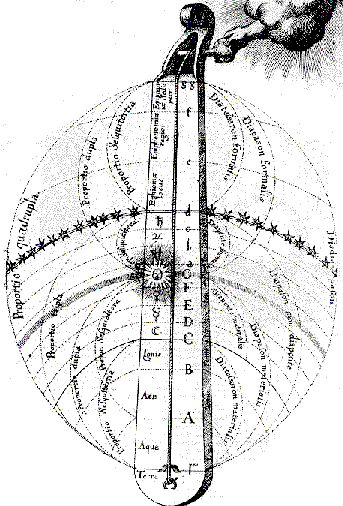
Subject: RE: BS: Fun with music theory From: josepp Date: 04 Dec 10 - 03:24 PM This brings us to String Theory. Much has been written about it and I won't go into a big explanation of it but physicist Kaku Michio states: "The superstring theory...assumes that the ultimate building blocks of nature consist of tiny vibrating strings. If correct, this means that the protons and neutrons in all matter, everything from our bodies to the farthest star, are ultimately made up of strings. Nobody has seen these strings because they are much too small to be observed. (They are about 100 billion billion times smaller than a proton.) According to superstring theory, our world only appears to be made of point particles, because our measuring devices are too crude to see these tiny strings." Kaku also writes: "The superstring theory can produce a coherent and all-inclusive picture of nature similar to the way a violin string can be used to 'unite' all the musical tones and rules of harmony...Similarly, in superstring theory, the fundamental forces and various particles found in nature are nothing more than different modes of vibrating strings. The gravitational interaction, for example, is caused by the lowest mode of a circular string (a loop). Higher excitations of the string create different forms of matter. From the point of view of the superstring theory, no force or particle is more fundamental than any other. All particles are just different vibratory resonances of vibrating strings." Physicist John Wheeler once postulated that the entire universe may be composed not of subatomic particles, but of one particle—a single electron. Wheeler postulated that the Big Bang propelled this electron forward in time until it reached the very end—doomsday or the Big Crunch, if you will. Upon hitting this Big Crunch, the electron is propelled backward in time until it hits the Big Bang again where it is again propelled forward in time until it is propelled back again by the Big Crunch. It has been and is still doing this billions upon billions upon billions of times. Depending upon the "speed" that the electron is propelled in time and depending on whether it is travelling forward or backward causes us to see each pass the electron makes as a different particle. IOW, all particles in this universe are really a single electron at different vibratory states. As a concept, it appears flawed but actually it works quite nicely and has a wonderful elegance to it. No one as yet has managed to prove that it cannot be true but admittedly has not been proven as correct either. Kaku takes Wheeler's idea one step further by postulating that instead of a single electron, there might be only a single string vibrating away between Big Bang and Big Crunch creating particles wherever its vibrations "bunch up". Perhaps that is our ultimate drummer, the origin of our universal beat—a single tiny vibrating string totally hidden from us and totally mysterious. If true, it lends new meaning to the "monochord" or "one string" of alchemist Robert Fludd (1574-1637). The drawing below is his conception of this monochord whose resonance brings the universe into existence and whose vibration we all dance to. Fludd's Cosmic Monochord |
|
Subject: RE: BS: Fun with music theory From: Stringsinger Date: 04 Dec 10 - 03:53 PM If you listen closely to the Jupiter example it seems to be that low Bb in the bass, middle F,G and Bb are in the foreground and that Db and E are in the overtones above. That would make this a Bbm6(b5). Jupiter is a pretty jazzy place. |
|
Subject: RE: BS: Fun with music theory From: josepp Date: 04 Dec 10 - 03:56 PM Which mode would that be? |
|
Subject: RE: BS: Fun with music theory From: Stringsinger Date: 04 Dec 10 - 04:02 PM It appears that Deep Space signals on the example oscillate between B natural and an octave above then shift to a high B natural to a Bb below then a high A to an F# above and then a microtone between an A natural and B natural to a high F. These are identifiable pitches and I don't know what they mean musically. (If they could be identified, would they represent some harmonic signal? Wishful thinking.) |
|
Subject: RE: BS: Fun with music theory From: Smokey. Date: 04 Dec 10 - 04:02 PM Josepp, old bean, if this is your idea of 'fun', you really need to get out more. |
|
Subject: RE: BS: Fun with music theory From: Stringsinger Date: 04 Dec 10 - 04:08 PM Sound of Earth is unintelligible by pitches but Uranus seems to center somewhere between high G and down to C# or Db. Tritone. |
|
Subject: RE: BS: Fun with music theory From: josepp Date: 04 Dec 10 - 04:13 PM Tritone? Huh-oh! The Devil's interval! |
|
Subject: RE: BS: Fun with music theory From: Don Firth Date: 04 Dec 10 - 04:14 PM A fifth is not a scale, even a small one. It is an interval. I don't have time now to wade through all this stuff, but a scan of the earlier posts makes it clear that much of it is derived from Pythagoras' experiments with a "monochord." What Pythagoras discovered was the overtone series. This is inherent in any kind of vibrating body, be it a taut string, a column of air, a ringing bell, a vocal fold. . . . Often called "harmonics." All over a guitar fingerboard. Pythagoras went on to derive scales from this. After discovering the octave (half the length of a string—ration, 2 to 1—noticeably "the same note only higher"), he tried one third the length of a string and found a distinctly different note (3 to 1—later on, determined to be an interval of a fifth when fit into the scheme of the other notes he discovered). He tuned another string to this different note and did the same thing: one third the length, and he tuned another string to this note. He continued this process until he found that he was repeating notes he already had. He had twelve distinct notes. What Pythagoras had done was to discover what we now call the "chromatic scale." Note: he did not invent it, he discovered it. The notes modern musicians use are not arbitrary, they are inherent in nature. It's physics. Nothing arbitrary or mystical about it. But— Pythagoras, for all his valuable discoveries, including such things as the rule for finding the length of the hypotenuse of a right triangle, was a bit of a nut. His idea was that the Cosmos was made up of numbers. Not just that it could be measured and often defined in terms of numbers, but that the Cosmos consisted—literally—of numbers. A 7 over here, a 4 over there, a 13 somewhere else, all orbiting around each other to the Music of the Spheres and each with a mystical significance of its own. Well—whatever turns your crank. The rest of this stuff sounds like it's been filtered through the mind of Edgar Cayce on a bad batch of LSD. Sorry. There is no great mystical significance to any of this. Don Firth P. S. By the way, Michio (first name) Kaku (last name) is a thoroughly grounded theoretical physicist, but he does indulge in a great deal of speculation. As in "Wouldn't it be interesting if--". I've read a lot of his stuff, and you want to be sure you know when he's giving the straight scoop and when he's indulging in a flight of fancy. Fascinating stuff, but caveat emptor. HE makes it quite plain what he's doing at any given time, but lots of people love to skip over that, grab a piece of his speculation, and declare "Michio Kaku says--" So you gotta be careful when somebody quotes him out of context! |
|
Subject: RE: BS: Fun with music theory From: Stringsinger Date: 04 Dec 10 - 04:25 PM It's interesting how you can almost determine actual musical pitches from some of the examples. Re: Jupiter Bbm6(b5 could be interpreted as a blues mode 1,5,6,1,b3,b5,6 It almost sound Phrygian if you took the E natural as the starting point of the scale. You would have E,F,G,Bb,Db (Maybe a Jupiter variation of Phrygian mode). |
|
Subject: RE: BS: Fun with music theory From: Stringsinger Date: 04 Dec 10 - 04:31 PM "Fibonacci's Dream" is very pretty but sounds pretty tonal ala DADGAD or Spanish cadences. Don't get any unusual progressions or chords out of it. Kinda' new agey. Nice playing, though. |
|
Subject: RE: BS: Fun with music theory From: josepp Date: 04 Dec 10 - 04:32 PM There's no such thing as a first and last name in Japan or anywhere in the Far East that I am aware of. His name properly is Kaku Michio and that is how it should be said. Show a little respect. |
|
Subject: RE: BS: Fun with music theory From: josepp Date: 04 Dec 10 - 04:40 PM There's a musical scale called hexany that is based on the geometry of the dodecahedraon or something like that. All the explanations I've read about it, I do not get at all. I can't find any examples of it. |
|
Subject: RE: BS: Fun with music theory From: Smokey. Date: 04 Dec 10 - 04:43 PM I'm not convinced those recordings are genuine. For example, why is Uranus stereo? It sounds like late 60s - early 70s Moog to me - I spent years making noises like that. |
|
Subject: RE: BS: Fun with music theory From: Stringsinger Date: 04 Dec 10 - 04:46 PM Re: The law of fives, it is significant that the first attempt at harmony is organum built on intervals of fifths and then gynmel, on fourths. The fifth has a resonance in music that seems international. It is an essential part of the overtone series beyond the first octave. It's significant that as a harmonic device it doesn't sound discordant to most ears. I'm not sure the Law of Fives has anything practical to do with music but it engenders speculation. |
|
Subject: RE: BS: Fun with music theory From: josepp Date: 04 Dec 10 - 04:50 PM ////Josepp, old bean, if this is your idea of 'fun', you really need to get out more.//// Yes, this is my idea of fun and I am out. I'm sitting in a tea house as I type doing yet another open mic (too cold to busk otherwise I would be). |
|
Subject: RE: BS: Fun with music theory From: josepp Date: 04 Dec 10 - 04:57 PM ////I'm not convinced those recordings are genuine. For example, why is Uranus stereo? It sounds like late 60s - early 70s Moog to me - I spent years making noises like that.//// To my knowledge, these are real. But a fake could be synthesized but yu'd probably not know the difference. The first Saturn clip was obviously fake. But many of these are available on CD to the public so they're not hard to get hold of. As for stereo, go to the sferics link I posted and note that one of the examples of sferics recorded there is in stereo. We have the technology. We can record them louder. Crisper. Better than before. (that's from the 6 million dollar man in case you didn't know) |
|
Subject: RE: BS: Fun with music theory From: josepp Date: 04 Dec 10 - 05:03 PM ////Re: The law of fives, it is significant that the first attempt at harmony is organum built on intervals of fifths and then gynmel, on fourths. The fifth has a resonance in music that seems international. It is an essential part of the overtone series beyond the first octave. It's significant that as a harmonic device it doesn't sound discordant to most ears. I'm not sure the Law of Fives has anything practical to do with music but it engenders speculation.//// I mentioned that decans were divided into two and each half was called a quinary. Foolstroupe looked it up and saw it related to five-ness and went off about the law of fives which has nothing to do with anything I've written about here. Foolstroupe has a need to attack anything and everything I post and usually nips off one of his own limbs in the process. But, like most bottom-feeders, he'll regenerate a new one and be back in time to attack my next post. Don Firth runs a close second. On another thread he insisted that I read the writings of Kaku Michio to know what I was talking about. Now that I've quoted, Don comes back with, "Well, you can't take Kaku at face value!" Oh. |
|
Subject: RE: BS: Fun with music theory From: Smokey. Date: 04 Dec 10 - 05:05 PM I'd need a lengthy explanation of how it was possible to record a planet in stereo before I was convinced. It sounds like white noise manipulated through Moog or EMS filters and a spring reverb to me.. |
|
Subject: RE: BS: Fun with music theory From: josepp Date: 04 Dec 10 - 05:17 PM Some Sferics sound amazing like a human voice speaking but is just muffled enough that you can't quite make out what he's saying. Other times it sounds like frogs on a swamp. Some pulsars sound like someone stomping around in heavy boots in a large resonant empty room. I have a recording from space that sounds incredibly like Merzbow where if I hadn't gotten it from a University website who record and post their own sferic and outer space recordings would have been convinced that it was Merzbow. So while I can't say these defintely weren't faked (they're on youtube after all), it would be remarkable for me to have managed to pick at random nothing but faked recordings. |
|
Subject: RE: BS: Fun with music theory From: josepp Date: 04 Dec 10 - 05:23 PM Smokey, just google "nasa space recordings" and look at all the stuff that is available to the public. No lengthy explanations necessary. |
|
Subject: RE: BS: Fun with music theory From: Smokey. Date: 04 Dec 10 - 05:33 PM I don't necessarily doubt that the source white noise was recorded from space, but what I'm saying is that it's 'processed to buggery', to use a technical expression. |
|
Subject: RE: BS: Fun with music theory From: josepp Date: 04 Dec 10 - 05:50 PM And you know this because? |
|
Subject: RE: BS: Fun with music theory From: josepp Date: 04 Dec 10 - 05:56 PM pulsars |
|
Subject: RE: BS: Fun with music theory From: Smokey. Date: 04 Dec 10 - 06:23 PM And you know this because? If you mean 'how', I have extremely good ears and a hell of a lot of experience in such things. Besides, there aren't that many ways to produce a natural stereo recording, and 'from a spaceship' isn't currently one of them. I've heard pulsars, by the way, they're real enough recordings - I meant the planet recordings you linked to. |
|
Subject: RE: BS: Fun with music theory From: Smokey. Date: 04 Dec 10 - 06:33 PM - Specifically Uranus and Juptier - I haven't listened to the others. |
|
Subject: RE: BS: Fun with music theory From: Smokey. Date: 04 Dec 10 - 06:37 PM Jupiter - pardon my French. |
|
Subject: RE: BS: Fun with music theory From: Amos Date: 04 Dec 10 - 06:49 PM The output sound is not the sound of the planet, josep. Come on. It is a mathematical translation of frequencies from one part of the spectrum into sound frequencies. Do you seriously think planets suspended in vacuum make noise? Or do you think these sounds were recorded in the barely perceptible thin atmospheres of some planets, and yet somehow made sounds that are similar to Terran noise? Put your thinking cap on, dude. Your dissertations are very entertaining, but bear in mind that there is no map in the world as malleable as mathematics, and it easily floats far afield from the territory. Finding a bunch of quantitative similarities between disparate things is nothing magical, it is just innumerate. "Oh, look, there are five ducks crossing the road, and there are five cars lined up waiting for them, and five pedestrians watching and taking pictures!! Coincidence???? I don't THINK so...". |
|
Subject: RE: BS: Fun with music theory From: Smokey. Date: 04 Dec 10 - 06:57 PM similar to Terran noise I'd have said early Tangerine Dream.. |
|
Subject: RE: BS: Fun with music theory From: olddude Date: 04 Dec 10 - 07:10 PM Actually mathematics is the only real truth in the physical realm. Even random numbers are not truly random, As one of my colleagues at the university said, we just can't plot them yet. One of the more fascinating areas is that of chaos theory ... It is really quite interesting. |
|
Subject: RE: BS: Fun with music theory From: olddude Date: 04 Dec 10 - 07:26 PM A very good explanation that is not for the Math geeks on Chaos Theory is here http://www.imho.com/grae/chaos/chaos.html |
|
Subject: RE: BS: Fun with music theory From: Amos Date: 04 Dec 10 - 07:38 PM Fibonacci sequences and fractals and chaos patterns and emerging complexity are all interesting and may serve as pointers to something, I do not dispute. It's just that this wide-bladed scything down of numerical coincidences and churning them into a mystical magical brew of powers is jejune. A |
|
Subject: RE: BS: Fun with music theory From: josepp Date: 04 Dec 10 - 07:41 PM ////The output sound is not the sound of the planet, josep. Come on. It is a mathematical translation of frequencies from one part of the spectrum into sound frequencies. Do you seriously think planets suspended in vacuum make noise? Or do you think these sounds were recorded in the barely perceptible thin atmospheres of some planets, and yet somehow made sounds that are similar to Terran noise? Put your thinking cap on, dude.//// Well, thanks, for that explanation, Amos. Heavens to Betsy, I thought you just opened a window on the shuttlecraft and stuck your cellphone out into space and recorded the earth whooshing around in a vacuum. Silly me. |
|
Subject: RE: BS: Fun with music theory From: Smokey. Date: 04 Dec 10 - 07:46 PM Tsk, no. You'd need a pair of mics to get a stereo recording :-) |
|
Subject: RE: BS: Fun with music theory From: Jack Campin Date: 04 Dec 10 - 07:58 PM I was wondering where Conrad Bladey had gone. Different content, same style of interaction. |
|
Subject: RE: BS: Fun with music theory From: olddude Date: 04 Dec 10 - 08:05 PM Amos, pretty much correct but fun |
|
Subject: RE: BS: Fun with music theory From: olddude Date: 04 Dec 10 - 08:17 PM Planets do make sounds via radio waves ... check out Saturn from NASA's official website http://www.nasa.gov/mission_pages/cassini/multimedia/pia07966.html |
|
Subject: RE: BS: Fun with music theory From: Smokey. Date: 04 Dec 10 - 08:41 PM '"Time on this recording has been compressed, so that 73 seconds corresponds to 27 minutes. Since the frequencies of these emissions are well above the audio frequency range, we have shifted them downward by a factor of 44."' They did a similar trick with the humpback whale - fascinating stuff, but not really 'sound' as we know it, until it's processed. A bit like tickling the colours up on astronomy photographs I suppose. |
|
Subject: RE: BS: Fun with music theory From: olddude Date: 04 Dec 10 - 09:05 PM I feel the same way Smokey, but it is fun anyway .. and it is worthy of investigation by NASA |
|
Subject: RE: BS: Fun with music theory From: The Fooles Troupe Date: 04 Dec 10 - 09:10 PM "I mentioned that decans were divided into two and each half was called a quinary. Foolstroupe looked it up and saw it related to five-ness and went off about the law of fives which has nothing to do with anything I've written about here." It is the very core of your massive cut and paste inchoate attention seeking babbling. Your puerile ignorance is demonstrated by your put down of your betters who attempt to teach you that you don't know or understand what you are talking about. You are apparently incapable of understanding what was posted - the Law of Fives has nothing to do with the number five on the meta level of understanding that is its real meaning (Your Reality is based on your Preconceived Intent and that you can 'prove' anything with ignorance and determination). You also do not understand what Discordianism is about, any more than you could understand what the Religion of the Flying Spaghetti Monster is about. Unlike Our Verbose Troll, I actually have read this stuff, much of it when it was first published, I don't have to pretend to understand things by just doing massive amounts of cut and paste. I still have this LP - Bartel Diagrams - Sun Music There is Theory, and then there is Fantasy. |
|
Subject: RE: BS: Fun with music theory From: Smokey. Date: 04 Dec 10 - 09:14 PM I feel the same way Smokey, but it is fun anyway .. and it is worthy of investigation by NASA I fully agree. I once heard Wagner's Ring reduced to three tiny blips.. |
|
Subject: RE: BS: Fun with music theory From: Smokey. Date: 04 Dec 10 - 09:18 PM Foolestroupe, I've still got the trilogy somewhere, you've inspired me to dust it off and re-read it after about thirty years - thanks! |
|
Subject: RE: BS: Fun with music theory From: The Fooles Troupe Date: 04 Dec 10 - 09:30 PM "There's no such thing as a first and last name in Japan or anywhere in the Far East that I am aware of" The ignorant think that if they shout loud and long enough, they win. If you want to search and C&P for longer than I did, you will find much more: A list of common first and last names with alternate spellings in kanji. Japanese Names QUOTE Name order: In Japan, like in China and Korea, the first name follows the family name. A person with the first name "Ichiro" and the family name "Suzuki" is, therefore, called "Suzuki Ichiro" rather than "Ichiro Suzuki". UNQUOTE Japanese Boys' Names QUOTE Birth Order Names Until a generation or two ago, the most popular class of boys' names were birth order names: Taro (first), Jiro (second), Saburo (third), Shiro (fourth), Goro (fifth). Taro got so much play that it's a generic suffix for "boy" now. All of these names are now far, far out of style, though you might see them used as suffixes. UNQUOTE A list of most common Japanese family names ordered by prefecture. Wikipedia - Japanese Names QUOTE There are a few names that can be used as either surnames or given names ... In addition, to those familiar with Japanese names, which name is the surname and which is the given name is usually apparent, no matter which order the names are presented in. This thus makes it unlikely that the two names will be confused, for example when writing in English using the order family name, given name. However, due to the variety of pronunciations and differences in languages, some common surnames and given names may coincide when Romanized... UNQUOTE |
|
Subject: RE: BS: Fun with music theory From: Smokey. Date: 04 Dec 10 - 09:31 PM Principia Discordia |
|
Subject: RE: BS: Fun with music theory From: The Fooles Troupe Date: 04 Dec 10 - 09:37 PM "Some Sferics sound amazing like a human voice speaking but is just muffled enough that you can't quite make out what he's saying. " Yep - Law of Fives again ... same reason that people see images of faces in burnt toast, etc :-) |
|
Subject: RE: BS: Fun with music theory From: josepp Date: 04 Dec 10 - 09:41 PM ////They did a similar trick with the humpback whale - fascinating stuff, but not really 'sound' as we know it, until it's processed. A bit like tickling the colours up on astronomy photographs I suppose./// Yes, but you were saying earlier that they were cheating with a synthesizer. There's nothing wrong with adjusting the frequencies into the audible range or there would be nothing to hear. Then you brought up the stereo thing and I've already pointed out a legitimate sferics recording in stereo. I don't know how they do it and don't care but obviously it can be done at least in some instances. I would also imagine that signals coming from nearby planets would be far richer in audio quality than the rather sterile sounds we get from pulsars which are immense distances away. |
|
Subject: RE: BS: Fun with music theory From: josepp Date: 04 Dec 10 - 09:53 PM "I mentioned that decans were divided into two and each half was called a quinary. Foolstroupe looked it up and saw it related to five-ness and went off about the law of fives which has nothing to do with anything I've written about here." It is the very core of your massive cut and paste inchoate attention seeking babbling. Your puerile ignorance is demonstrated by your put down of your betters who attempt to teach you that you don't know or understand what you are talking about. /////You are apparently incapable of understanding what was posted - the Law of Fives has nothing to do with the number five on the meta level of understanding that is its real meaning (Your Reality is based on your Preconceived Intent and that you can 'prove' anything with ignorance and determination). You also do not understand what Discordianism is about, any more than you could understand what the Religion of the Flying Spaghetti Monster is about. Unlike Our Verbose Troll, I actually have read this stuff, much of it when it was first published, I don't have to pretend to understand things by just doing massive amounts of cut and paste. I still have this LP - Bartel Diagrams - Sun Music There is Theory, and then there is Fantasy.///// LOL! You gotta love this guy. He keeps trying. |
|
Subject: RE: BS: Fun with music theory From: The Fooles Troupe Date: 04 Dec 10 - 10:01 PM "they were cheating with a synthesizer. There's nothing wrong with adjusting the frequencies into the audible range or there would be nothing to hear." Precisely the point - there IS nothing to hear, until 'magic' is done on it! "I don't know how they do it and don't care but obviously it can be done at least in some instances." Which statement reveals that you would not know if you had been tricked into believing nonsense. "I would also imagine that signals coming from nearby planets would be far richer in audio quality than the rather sterile sounds we get from pulsars which are immense distances away. " Haha! Imagination is wonderful! And since no actual SOUND in audio frequencies we can hear without technical manipulation exists, you now need some mystical/magical 'Aether' substance which affect the transmisson of this 'signal' in some way to get your imagined effect. Once again, the Law of Fives (self delusion) reveals that you are just making this up as you go along without the benefit of using any Science. |
|
Subject: RE: BS: Fun with music theory From: josepp Date: 04 Dec 10 - 10:08 PM ////"There's no such thing as a first and last name in Japan or anywhere in the Far East that I am aware of" The ignorant think that if they shout loud and long enough, they win. If you want to search and C&P for longer than I did, you will find much more//// Would you trust a Japanese source to tell you all about how Western names work when you have firsthand knowledge that makes that source perfectly worthless to you? Wellllll... |
|
Subject: RE: BS: Fun with music theory From: Smokey. Date: 04 Dec 10 - 10:08 PM Don't play the misquoting game with me, Josep. You may not care how come the recording is stereo, or what the left and right sides are actually supposed to represent, but to me it's an important and relevant question. |
|
Subject: RE: BS: Fun with music theory From: Smokey. Date: 04 Dec 10 - 10:09 PM The one Chinese person I've known told me that surnames come first in China. |
|
Subject: RE: BS: Fun with music theory From: josepp Date: 04 Dec 10 - 10:18 PM But I gave you a link to an sferics site that has a stereo recording. It's obviously not a fake recording. Therefore it can be done. Instead of conceding that they apparently have a way of getting a stereo image, you keep intimating that this proves its falsity. My suggestion would be to go to a NASA or science site and ask them. I have a sneaking suspicion they might just tell you that it can be done in some manner. And where have I misquoted you? You clearly said at least a couple of times that you believed this was done with synths. When I asked how you knew that, you replied that you were some kind of expert at this kind of thing. I don't see where I misquoted you at all. |
|
Subject: RE: BS: Fun with music theory From: The Fooles Troupe Date: 04 Dec 10 - 10:25 PM "Would you trust a Japanese source to tell you all about how Western names work when you have firsthand knowledge that makes that source perfectly worthless to you? Wellllll..." Funny ,some at least of those sources quoted appear to be English translations of material by Japanese people. Would I trust a totally unknown anonymous Troll who claims that he has 'special knowledge beyond my understanding' and who has already massively displayed his ignorance and distorted misunderstandings of many things others and I have already spent much effort in studying, and who responds to any error correction by myself and others with loud put downs? Expert = Drip under pressure. "As a concept, it appears flawed but actually it works quite nicely and has a wonderful elegance to it. No one as yet has managed to prove that it cannot be true but admittedly has not been proven as correct either. " Sums up our compulsive cut and paster friend's contributions nicely. |
|
Subject: RE: BS: Fun with music theory From: josepp Date: 04 Dec 10 - 10:26 PM ////"they were cheating with a synthesizer. There's nothing wrong with adjusting the frequencies into the audible range or there would be nothing to hear." Precisely the point - there IS nothing to hear, until 'magic' is done on it!/// LOL! So when I talk about the connections between music and astronomy, it's all stupid, superstitious, old gobbledegook but when some engineer converts inaudible frequencies to the audible range--a very simple operation actually--it's "magic"? |
|
Subject: RE: BS: Fun with music theory From: Don Firth Date: 04 Dec 10 - 10:29 PM josepp, Michio Kaku is an American citizen. "Michio Kaku" is what he calls himself. So YOU have a little respect. Yes, I told you to read his writings. But I didn't reckon with the fact that you apparently don't have the brain power to distinguish between when he is dealing with hard physics and when he is speculating, even when he tells you which he's doing. And he is consistent about telling his readers which is which. Of course, you aren't interested in the real universe. You're into the occult. No reasoning with people like you. Don Firth |
|
Subject: RE: BS: Fun with music theory From: The Fooles Troupe Date: 04 Dec 10 - 10:29 PM "But I gave you a link to an sferics site that has a stereo recording. It's obviously not a fake recording. Therefore it can be done" Hah! As someone who worked in Theatre doing Sound and Light, that's easy to fake. And in Stereo, if you use a Stereo recording device. Even a blank tape, if played back loud enough gives you this effect. As well as mistuning an AM radio between stations. Been there, done that for fun decades ago. Sferics depends on The Law of Fives (self delusion). |
|
Subject: RE: BS: Fun with music theory From: The Fooles Troupe Date: 04 Dec 10 - 10:37 PM "when some engineer converts inaudible frequencies to the audible range--a very simple operation actually--it's "magic" " You said not only do you not know how it's done, you don't even care. Any sufficiently advanced technology is indistinguishable from Magic. Arthur C Clarke Any technology distinguishable from Magic is insufficiently advanced. Barry Cohen Any technology, no matter how primitive, is Magic to those who don't understand it. Florence Ambrose ... (and in the Spirit of The Old Music Hall Comics) Boom! Boom! :-) |
|
Subject: RE: BS: Fun with music theory From: Smokey. Date: 04 Dec 10 - 10:39 PM Those 'sferics' are random (ish?) radio interference recorded on a stereo receiver - of course they sound like stereo. If you recorded it on two stereo receivers and played it back from four corners it'd sound quadrophonic. That has nothing to do with the price of fish. I was talking about Uranus - that's a different kind of stereo altogether. |
|
Subject: RE: BS: Fun with music theory From: olddude Date: 04 Dec 10 - 10:44 PM interesting thread. I don't know everyone wants to fight. Josepp presented an argument. In Mathematics we do that all the time and then try to prove or disprove it using Mathematics .. Having spent a lifetime with numbers I am always amazed at the patterns that emerge . I do not believe in any form of numerology, but I do find chaos theory quite interesting. He presents his ideas about the number 5. I cannot concur with it but I find it interesting to do some fractal work .. kinda fun actually ... so why the hard feelings? don't understand |
|
Subject: RE: BS: Fun with music theory From: Smokey. Date: 04 Dec 10 - 10:50 PM No hard feelings from here, OldDude. I've spent many absorbing hours exploring the Mandelbrot set, btw. |
|
Subject: RE: BS: Fun with music theory From: olddude Date: 04 Dec 10 - 10:54 PM Mandelbrot set .. we are kindred spirits my friend |
|
Subject: RE: BS: Fun with music theory From: josepp Date: 04 Dec 10 - 11:01 PM /////Have you calculated what frequency that is? Cycle length 2^49 seconds, i.e. 5.629 x 10^14. Seconds in a year, 3.156 x 10^7. So the time for one beat would be about 18 million years. josepp, the rest of your "theory" is similar tabloid crap. Take it to the letters page of the Weekly World News.///// Okay, genius--here you go from NASA's own website: http://science.nasa.gov/science-news/science-at-nasa/2003/09sep_blackholesounds/ |
|
Subject: RE: BS: Fun with music theory From: Smokey. Date: 04 Dec 10 - 11:02 PM I used to have Kai's Power Tools - it did quaternions too, but you had to be patient. |
|
Subject: RE: BS: Fun with music theory From: josepp Date: 04 Dec 10 - 11:03 PM /////Those 'sferics' are random (ish?) radio interference recorded on a stereo receiver - of course they sound like stereo. If you recorded it on two stereo receivers and played it back from four corners it'd sound quadrophonic. That has nothing to do with the price of fish. I was talking about Uranus - that's a different kind of stereo altogether.//// sferics is caused by lightning and it's only picked up on AM receivers. |
|
Subject: RE: BS: Fun with music theory From: Smokey. Date: 04 Dec 10 - 11:16 PM Yes Josep, I read that. |
|
Subject: RE: BS: Fun with music theory From: josepp Date: 04 Dec 10 - 11:19 PM The Syntonic Comma Now, if we form a circle of the C major octave where the full octave is 360 degrees exactly, then C=0 and 360, D=320, E=288, F=270, G=240, A=216, B=192, and C'=180. From D to F is a minor 3rd (3 half-steps) with a ratio of 320/270 or 6.4/5.4 even though the true ratio should 6/5 or 324/270. So the actual difference is 324/320 or 81/80. That ratio is called the syntonic comma. From C to G is a perfect 5th of 360/240 or 3/2. However, if we were to measure a perfect 5th in the next octave from D to A or 320/216 ratio, we notice that it is an 80/54 ratio. A true perfect 5th would be 81/54 or 3/2 and so, again, we end up with a discrepancy of 81/80 (oddly, the reciprocal of this number is 0.987654321). The next octave after that would yield the major 6th (F-D) and the perfect 4th (A-D) also off by the syntonic comma. The comma is very noticeable and must be dispersed in some manner. So even in a perfect 12-note scale, we must temper it to keep the octave at an exact 2:1 ratio because of the syntonic comma. Methods of Dispersing the Comma Method I One way to disperse the comma is through adjusting the major 3rds in the octave. In a 12-tone octave, there are three major 3rds (4 half-steps x 3 = 12 half-steps). A true major 3rd has a 5:4 ratio, that is, if you shorten a string by 4/5 but retain the same tension, the string will play a major 3rd interval higher. If we start at middle C, our three major 3rds would be C-E, E-G#, Ab-C (remember that Ab is the enharmonic equivalent of G#). Since the octave interval must always be an exact 2:1 ratio, the Ab-C major 3rd will be a bit flat. Why? Since a major 3rd is 4/5, then we would cube that ratio to obtain 64/125 for the full octave. But a full octave is 64/128 (1:2 ratio). Since 64/125 represents a longer string length than 1/2, the major 3rds will be noticeably flatter than in a true octave since a string's length is proportional to the pitch. The discrepancy is the ratio of 125/128 or 0.9765625, which is called a diesis. Each major 3rd interval in the octave must be sharpened slightly by a third of the diesis or about 0.3255208333. Method II We may also measure the minor 3rds in an octave of which there will be four. Using C major as an example and starting at middle C, our minor 3rds will be C-Eb, Eb-F#, F#-A and A-C'. Since a true minor 3rd would have 5/6 ratio, then the total value of an octave in minor 3rds is 5/6 raised to the power of 4 or 625/1296. The actual value of a full octave is 648/1296 or 1/2. Since the string length of an octave of minor 3rds is somewhat shorter than a true octave resulting in a higher pitch, the minor 3rds will be a bit sharp and must be uniformly flattened. So, the ratio of 648/625 or 1.0368 tells us the total difference in tone and so each minor 3rd interval must be flattened by a quarter of 1.0368 which is 0.2592. While other ratios are called a comma or diesis, this 648:625 ratio has never been named for some reason. Method III Suppose we measure the 5ths in an octave. There's only one 5th in an octave. Two 5ths will pass out of the octave. So, if we start measuring 5ths, we have to find a way to keep the tones within the octave. Once the 5th is out of the octave, its value must be halved to keep it within the octave. Starting at C, for example, the first 5th interval ends at G and we know that the ratio is 3/2 (or 2/3). The next 5th takes us to D and so we would square 3/2 to obtain 9/4 but that passes out of the octave (is greater than 2 and an octave must be exactly 2/1). So we multiply 9/4 by 1/2 to obtain 9/8, which is less than 2 and so is within the octave. Next, we jump up to A which is mathematically obtained by multiplying 9/8 by 3/2 or 27/16 which is within the octave. If we keep going through 5ths until we pass through all 12 semitones (after A, we go to E, B, F#, C#, G#, D#, A#, F and C) we end up with a final value of 262144/531441. The true octave, however, would yield 262144/524288. Again, the actual length of the string would be somewhat shorter than the true octave string length and so would be sharp. Our differential is the ratio of 531441/524288 and is called the ditonic comma (not "diatonic"). The value of the ratio is approximately 1.01364327. So we would flatten our 5ths by 1.01364327/12 or about 0.08447. This is the method mentioned earlier for tempering the 12-tone scale. |
|
Subject: RE: BS: Fun with music theory From: The Fooles Troupe Date: 04 Dec 10 - 11:41 PM QUOTE /////Those 'sferics' are random (ish?) radio interference recorded on a stereo receiver - of course they sound like stereo. If you recorded it on two stereo receivers and played it back from four corners it'd sound quadrophonic. That has nothing to do with the price of fish. I was talking about Uranus - that's a different kind of stereo altogether.//// sferics is caused by lightning and it's only picked up on AM receivers. UNQUOTE You really know very little, mate. The more often you try to pretend you know what you are talking about, the more you display your ignorance. AM Stereo :-) |
|
Subject: RE: BS: Fun with music theory From: The Fooles Troupe Date: 04 Dec 10 - 11:51 PM Re "The Syntonic Comma " Big Cut&Paste waste of space ... The Real Musicians who know their theory and have passed their Exams (as well as a lot of others) know this. It's the original reason for 'Temperment' which you probably forgot you cut and pasted huge chunks about. Howard Goodall even did a book and BBC TV documentary about this and many well known (but to you apparently 'ocult') Music Concepts called "Big Bangs: Five Musical Revolutions. by Howard Goodall" - easily Googled... |
|
Subject: RE: BS: Fun with music theory From: josepp Date: 05 Dec 10 - 12:06 AM Counting by perfect 5ths allows us to construct the entire 12 scales and their relative majors/minors but can we count by any other intervals and still be able to construct a complete scale? Yes, we know we can make a complete Circle of 5ths and we can also make a Circle of 4ths. All we need to do is follow the order of the 5ths in reverse since perfect 4ths are merely perfect 5ths inverted and vice-versa. Both circles are mirror images but otherwise identical. Can we make complete circles of other intervals? Yes, we can. We can make a complete circle of minor 2nds. Since a minor 2nd is a half-step, of course we can travel around the circle in half-steps since there are twelve of them. So, logically, we should be able to take the inverse of the minor 2nd and make a circle of it too. And we can. The reciprocal of the minor 2nd is the major 7th (eleven half-steps from the tonic) and it too ends up tracing out the circle semitone by semitone. Can we make a circle with major 3rds? No. We eventually begin repeating scales without naming all twelve. This happens with any intervals other than the 4th, 5th, half-step and major 7th. Why? Because a 4th is 5 half-steps, a 5th is 7 half-steps, a minor second is 1 half-step and a major 7th is 11 half-steps, and the octave is 12 half-steps. 1, 5, 7 and 11 are what we say in mathematical jargon co-prime in modulo 12. That is, they are not divisible with any number other than 1 and themselves and also share no factors with 12. All the other intervals are not prime or are factors of 12 or both and so end up creating circles that are factors of 12 but never all 12. |
|
Subject: RE: BS: Fun with music theory From: josepp Date: 05 Dec 10 - 12:15 AM /////Re "The Syntonic Comma " Big Cut&Paste waste of space ...//// LOL! I find your jealousy towards me both hilarious and flattering. |
|
Subject: RE: BS: Fun with music theory From: Don Firth Date: 05 Dec 10 - 12:40 AM I took three years of music theory at the University of Washington School of Music. One of my professors was composer-in-residence John Verrell, one summer of private lessons with composer Mildred Hunt Harris, then another two years at the Cornish School of the Arts (a conservatory). Cornish also offered courses in the physics of music, which I also took. (This, along with singing and classic guitar lessons). So I can speak with some degree of authority. josepp, the wheel was invented a long, long time ago. And there is nothing mystical or occult about it. Don Firth |
|
Subject: RE: BS: Fun with music theory From: josepp Date: 05 Dec 10 - 01:19 AM Upon listening to the Jupiter clip through headphones, I have to conclude it is fake. It's too perfect. Definitely done on a synth. I confirmed it by locating NASA's Jupiter recording and it sounds nothing like the youtube recording and sounds a lot more like a true EM radiation reception: Jupiter |
|
Subject: RE: BS: Fun with music theory From: josepp Date: 05 Dec 10 - 01:41 AM ////Of course, you aren't interested in the real universe. You're into the occult. No reasoning with people like you. Don Firth//// Gee, Don, nobody keeping you here that I'm aware of. As for Mr. Kaku--call him what you want, I don't care. I was just being a prick to you so you know how it feels. |
|
Subject: RE: BS: Fun with music theory From: Smokey. Date: 05 Dec 10 - 01:53 AM Now have a good listen to Uranus, Josep.. |
|
Subject: RE: BS: Fun with music theory From: Don Firth Date: 05 Dec 10 - 02:32 AM Speaking of pricks, josepp, your constant copying-and-pasting is pretty limp. At least I'm a stand-up guy. Don Firth |
|
Subject: RE: BS: Fun with music theory From: The Fooles Troupe Date: 05 Dec 10 - 03:19 AM I did 5th Grade Music Exams Practical and Theory (Harmony and Basic Composition) - started 6th Grade theory, but above 5th Grade it was all just about dead composers, and obsolete styles of music I was not interested in at the time. If you really wanted to be serious about Music Theory, and be taken seriously with all this massive redundant (this IS a Music Forum!) cut and paste stuff that you are trying to 'educate' us with (but you are only preaching to the choir!), you would have done a thread above the line, not in BS (= "Bullshit"), one definite reason why nobody is taking you seriously. "I don't care. I was just being a prick to you so you know how it feels. " Signs of a Superiority Complex - needing to constantly prove how superior he is, and also definitely a Narcissist. Another reason why none of this cut and paste garble is to be taken seriously. "Gee, Don, nobody keeping you here that I'm aware of." Et Tu, Brute. |
|
Subject: RE: BS: Fun with music theory From: The Fooles Troupe Date: 05 Dec 10 - 03:22 AM "I find your jealousy towards me both hilarious and flattering. " Not Jealousy, only Pity. |
|
Subject: RE: BS: Fun with music theory From: josepp Date: 05 Dec 10 - 12:06 PM ////Now have a good listen to Uranus, Josep..//// I would say anything off that particular CD is fake. Not sure about the 2nd Saturn clip I posted unless it too came off that CD. That first Saturn clip was fake beyond all reasonable doubt. The deep space sounds I'm not sure of. It sounds real. The earth-from-space clip is definitely fake. The sferics and pulsar clips are definitely real. |
|
Subject: RE: BS: Fun with music theory From: josepp Date: 05 Dec 10 - 12:13 PM ///Speaking of pricks, josepp, your constant copying-and-pasting is pretty limp./// Cut and paste from my own Word documents which I wrote them on. One was posted on a British website many years ago and the hostess posted it but she anglicized the way large numbers are written and spelling "favor" as "favour", which I liked, so I recopied it. That was several years ago and I doubt her website is still up. If anyone can prove I did not write these (I write for a living, you know, that is my sole source of income), I welcome the challenge. Find the true source and let us all know what it is. Good luck, you'll need it. ////At least I'm a stand-up guy.//// I'm tired of slinging insults so I won't even bother to get into faults of your character. Whatever you say, Don. |
|
Subject: RE: BS: Fun with music theory From: josepp Date: 05 Dec 10 - 12:23 PM ////Not Jealousy, only Pity.//// You and Don must be fascinated by my writing--that must be it. But you hate yourselves for it so you just have to attack everything to convince yourselves there's nothing to it. Otherwise, just leave. No one is stopping you. Everyone else here seems capable of reading what I wrote and putting it into perspective of not taking it too seriously but it's good info to keep in mind but you two are--the only word that comes to mind--bizarre. All I can do is put up with it because it's obvious the two of you simply cannot stop. Secret fans that are not so secret. You will read everything I write and hang on every word and hate yourselves for it but you'll keep doing it. If I was a celebrity, this would be called stalking. |
|
Subject: RE: BS: Fun with music theory From: josepp Date: 05 Dec 10 - 02:08 PM I think I'll buy that CD, Smokey. It's got some nice stuff on it even if it is fake. I'll see if it has liner notes. |
|
Subject: RE: BS: Fun with music theory From: Smokey. Date: 05 Dec 10 - 04:09 PM I would say anything off that particular CD is fake. I'm glad we can agree on that, at least. I trust my ears. I rather liked it too, actually, but I'm skint until well after Christmas. Let me know if there's anything interesting in the notes if you get it. |
|
Subject: RE: BS: Fun with music theory From: Smokey. Date: 05 Dec 10 - 05:41 PM Here's half an hour of "Jupiter" which is pleasant on the ear, but about as genuine as my talent for ballet dancing. |
|
Subject: RE: BS: Fun with music theory From: The Fooles Troupe Date: 05 Dec 10 - 07:17 PM "Cut and paste from my own Word documents which I wrote them on." You mean you rewrote the stuff from other older material you found, not that you made it up totally yourself (possibly by divine inspiration?) with no outside research of previous writings on the subject. Noting really wrong with that, in and of itself. But even the best intentioned can find it very character forming to realise they sometimes get the wrong end of the stick, and make mistakes. "you just have to attack everything to convince yourselves there's nothing to it." You can have whatever OPINION of things you want: just don't try to convince others (or even worse, yourself) that you never get a weird mystical occult slant opinion (as explained by the Philosophical point about the Law of Fives) on straight forward things and attack those who attempt to improve your education. No jealousy: when you can demonstrate that you understand things that others do, and don't make sweeping claims that you know everything better than others possibly could, then you might get respect. When you demonstrate respect for others, you might get shown some yourself. Stalking? You're the one that came here, and keeps coming back with insults and massive amounts of unattributed (you only now claim to be your own old rewritings) cut and paste about weird occult things in a BS thread. This is a Music Forum, that also tolerates a bit of rugged good natured play in BS threads about any sort of weird opinionated shit. That is why this section is labeled BS. If you had started a Music Thread (no BS prefix) above the line with the preface that the following was YOUR OWN OPINION and INTERPRETATION rather than taking the line that you had some mystical deeper revelation of the occult withheld from the rest of us mere mortals, many of who have been around Music for a very long time, you might even have been congratulated on YOUR OPINION. Taking up other BS threads about things like the Shakespeare Conspiracy and other contentious non music topics first, did not help you trying to present your own personal opinions about the 'magic of music' in a BS thread either! :-) |
|
Subject: RE: BS: Fun with music theory From: Don Firth Date: 05 Dec 10 - 09:50 PM The music theory stuff, as far as it goes—not all that far—is, as I noted earlier, as old as Pythagoras. There have been a few refinements since then, which josepp's screed simply skips over. As to the mystical "Music of the Spheres" stuff, that, too, is as old as the hills. Superstition and speculation back in the days of Thales, Aristotle, Socrates, et al. This stuff, as josepp presents it, is thoroughly lathered with bits and pieces from Madame Blavatsky, the Rosicrucians (ads in "Horoscope" magazine), and a guy who used to run around in a burnoose, give lectures on what he claimed were the teachings of the ancient Coptic religion, and who also claimed to have reincarnated more than a thousand times and said he remembered each of those lives. (THIS is the guy!!). He financed himself through lecture fees, and by selling vitamins. And, allegedly, bilking gullible, blue-haired ladies out of their Social Security money. Begged for contributions to keep his great work of trying to Enlighten the World going. What's to be jealous of? Something akin to pity and contempt is more appropriate. Don Firth P. S. josepp probably even channels Shirley MacLaine. You remember, she was the actress who went mystical and said she was channeling an ancient Atlantean warrior. |
|
Subject: RE: BS: Fun with music theory From: The Fooles Troupe Date: 05 Dec 10 - 10:04 PM Don, that wasn't Xena, was it ... no sorry, wrong actress ... Coptic? , no sorry I got confused with the Ancient Celtic Potato Goddess... And as for our friend, he is just the latest in a long line that just keep coming out of the woodwork, Waving Poetry about all sort of topics, Keeping Folk Music Free, ... oh, I can't remember them all. At least our Keep it Free guy had the courage to tell us up front that it was his own writing ... got some respect for that point alone, even if he wouldn't listen to what people were telling him about his ideas being basically good, and actually working in places, but not practical to insist that everybody should do it hos way ... Robin |
|
Subject: RE: BS: Fun with music theory From: Don Firth Date: 06 Dec 10 - 01:45 AM josepp, are you familiar with Ani Williams? Or--ARE you, perhaps, Ani Williams? Don Firth |
|
Subject: RE: BS: Fun with music theory From: s&r Date: 06 Dec 10 - 06:40 AM Or also known as Jor, a poster elsewhere on the web? Stu |
|
Subject: RE: BS: Fun with music theory From: josepp Date: 06 Dec 10 - 11:52 AM Yes, I was Jor in another forum. That was quite some time ago, though. Nice to know my posts are still there. Trace em back as far as you want, they will always come back to me. They have to. I wrote them. |
|
Subject: RE: BS: Fun with music theory From: olddude Date: 06 Dec 10 - 11:59 AM I wish I understood the anger. I really do, I don't get it. In Mathematics some of the coolest things have come out of some really odd ball ideas. Who would have guessed the Kotch curve. Now do I agree with Josepp ... no .. but he has some interesting concepts that are fun to work on using Mandelbrot Gosh I must have missed something that everyone is so angry with him. |
|
Subject: RE: BS: Fun with music theory From: josepp Date: 06 Dec 10 - 12:06 PM Don, I do not know who Ani Williams is. If this person posted word-for-word anything you see posted here under my moniker then that person has ripped me off. Not that I care. I don't get paid for these particular writings. It's more of a hobby. Anyone here can copy and paste them anywhere they want to. I don't care. You can even take credit for it--unless you're making money from it. But I will always have the earliest post dates to prove I posted them before you so if you are getting paid for taking my posts, let me know. I'm willing to work out a deal. If I find out some other way, you'll be talking to my lawyer and I will take everything. |
|
Subject: RE: BS: Fun with music theory From: josepp Date: 06 Dec 10 - 12:14 PM Don't sweat it, olddude. If that's how they want to be--bring it, baby! |
|
Subject: RE: BS: Fun with music theory From: olddude Date: 06 Dec 10 - 12:16 PM When you store data on a computer, you have to retrieve that data. I/O is the biggest performance issue on any computer. So you store the key and the location in an index (a lookup), or you hash the key to a specific disk location and try to locate the record Mathematically. Now the number of records a disk can hold is determined by the format. On hashing if the number of records a disk can hold corresponds to a 4K + 3 Prime, the number of searches is dramatically reduced. Who would have figured, it took a lot of work to prove that out in the earliest days of computing with Relational databases. I once published a software algorithm for CRC-16 error detection and correction that made a chip obsolete. Odd ball ideas can have some interesting twists for sure. Still don't understand the anger on a fun post with a rather odd idea. I like Math's odd ideas. |
|
Subject: RE: BS: Fun with music theory From: Don Firth Date: 06 Dec 10 - 02:28 PM Nobody's ripping you off, josepp. Ani Williams. Click in the middle of the graphic. No anger here, olddude. What I'm about is that I am very much a science and mathematics junkie, and I don't like to see someone dipping into carefully selected scientific information, ignoring anything that might contradict a pet idea, and then making use of "cherry-picked" data to attempt to lend authenticity to some system of pure mysticism. And that goes for any organized and marketable mystical system, especially one that can be marketed to the ignorant and gullible. I object just as much to such things as "intelligent design," and attempt by Creationists to lend scientific weight to their religious ideas. Don Firth |
|
Subject: RE: BS: Fun with music theory From: olddude Date: 06 Dec 10 - 03:16 PM When I discuss Mathematics, it is in the Physical world, How seemingly disassociated actions result in patterns. IE. Chaos Theory. I do not attempt Mathematics to explain the Spiritual world. I am a Christian that is my belief system and it works for me and a lot of other scientists that I know. Everyone is entitled to their own belief systems. That is all that I am saying. No need for anger |
|
Subject: RE: BS: Fun with music theory From: The Fooles Troupe Date: 06 Dec 10 - 08:15 PM Well Don, you said it before me and much more eloquently that I could come up with at the moment. QUOTE No anger here, olddude. What I'm about is that I am very much a science and mathematics junkie, and I don't like to see someone dipping into carefully selected scientific information, ignoring anything that might contradict a pet idea, and then making use of "cherry-picked" data to attempt to lend authenticity to some system of pure mysticism. And that goes for any organized and marketable mystical system, especially one that can be marketed to the ignorant and gullible. I object just as much to such things as "intelligent design," and attempt by Creationists to lend scientific weight to their religious ideas. UNQUOTE You're also more polite. Instead of mysticism, I would have said gibberish ... Long Live the Ancient Celtic Potato Goddess! |
|
Subject: RE: BS: Fun with music theory From: The Fooles Troupe Date: 06 Dec 10 - 08:21 PM Lest We Forget... Our Troll cleverly thought that attacking me as a deluded psychotic because of my mythical diabetes would dispose of me. Just did the scheduled starvation sugar test again the other week - no problems. :-) Then he tries running to Mommy crying that The Big Bad Angry Men are attacking him - again ... Been Bullied by Alcoholics and Psychos before to the point that it did affect my health, so when someone tries playing that game (just for fun!) I'm not likely to be very nice or open to spontaneous forgiveness. |
|
Subject: RE: BS: Fun with music theory From: olddude Date: 06 Dec 10 - 08:51 PM I guess I missed something, have no idea of past posts or bullying or anything but I don't read all the posts and figure you folks will resolve whatever issues you have. I will leave it at that |
|
Subject: RE: BS: Fun with music theory From: josepp Date: 06 Dec 10 - 09:49 PM Olddude, I guess we both missed something because I have no idea what Fool is talking about but then who does--least of all him? Don, the Ani Williams stuff is interesting but a bit new-agey for me. I'm old-agey. I'm interested in the old, old, old stuff. When humanity began to look up at the sky. While science is certainly useful, it is at least as destructive as it is useful. For everything science gives us, it takes at least twice as much from us. It could save us from being hit by an asteroid but it will never save us from ourselves. And anyone who says there's nothing mystical about music shouldn't be playing or listening to music--in fact, they don't. They go through motions and hear through dead ears. |
|
Subject: RE: BS: Fun with music theory From: Don Firth Date: 07 Dec 10 - 12:43 AM The new agey folks always claim that what they're peddling is very, very old agey. No surprises there. By the way, olddude, I'm not objecting to Christianity. What I do object to are those who want to perpetuate an ignorant view or the Cosmos and man's development in it in order to perpetuate early myths, such as the Genesis story. Nothing wrong with the Genesis story, as long as one realizes that it's a metaphorical story, not literal history. By the way, have a joyful Yuletide. Don Firth |
|
Subject: RE: BS: Fun with music theory From: The Fooles Troupe Date: 07 Dec 10 - 12:48 AM QUOTE From: josepp - PM Date: 06 Dec 10 - 09:49 PM I have no idea what Fool is talking about but then who does--least of all him? UNQUOTE Ah - Our Troll is either an outright bare faced liar or the delusional Narcissist he accuses others of being .... QUOTE Subject: RE: BS: Hamlet and the Christmas Tradition From: josepp - PM Date: 22 Nov 10 - 12:43 PM Foolestroupe is an example of what happens when diabetics stop taking their insulin. Get a grip, boy! People here just trying to have some fun. UNQUOTE |
|
Subject: RE: BS: Fun with music theory From: The Fooles Troupe Date: 07 Dec 10 - 12:51 AM QUOTE And anyone who says there's nothing mystical about music shouldn't be playing or listening to music--in fact, they don't. They go through motions and hear through dead ears. UNQUOTE So of course Our Troll, who has a special mystical occult understanding beyond the possible understanding of the rest of us mere mortals, will show us the way. Just send him your cheques... |
|
Subject: RE: BS: Fun with music theory From: josepp Date: 07 Dec 10 - 12:32 PM ////By the way, olddude, I'm not objecting to Christianity. What I do object to are those who want to perpetuate an ignorant view or the Cosmos and man's development in it in order to perpetuate early myths, such as the Genesis story. Nothing wrong with the Genesis story, as long as one realizes that it's a metaphorical story, not literal history.//// Except the ones who insist it is a metaphor usually have no idea of what the metaphor is anymore than the ones who take it as a history. Isn't that right, Don? ////So of course Our Troll, who has a special mystical occult understanding beyond the possible//// No, Fool, just beyond you. |
|
Subject: RE: BS: Fun with music theory From: Don Firth Date: 07 Dec 10 - 04:34 PM josepp, take your meds. I know perfectly well what the metaphor is all about. Not to mention metaphor in general. Have you ever heard of James Campbell? I didn't think so. I have several of Campbell's books, and I watched the series of television interviews with Campbell done some years ago by Bill Moyers on PBS. Excellent series. A thorough understanding of what Campbell was talking about is a wide doorway into understanding mythology in general, including the extensive use of myth and metaphor by various religious beliefs and mystical systems. It is also a great aid to writers of both fiction and non-fiction. Where many religious folks and people dedicated to various belief systems go off the rails and lose all genuine core understanding of those beliefs is when they assume that the teaching metaphors used by these systems are literal fact, such as the idea that the entire Cosmos was created in seven 24-hour periods and that we all descended from an actual, historical Adam and Eve. Some people can get pretty nasty toward those who don't buy a particular myth as literal truth. Look at the hot water Galileo got into with the Church over his discovery (along with Copernicus) that the Earth is not the center of the universe. After all, God created the world and made Adam in His own image, so how could the earth not be the center of the universe!?? Blasphemy!! When religious folks had, essentially, a monopoly on secular power as well as rigid religious doctrine, if you disagreed with something within that doctrine, it could get you burned at the stake! And there are factions in the United States right now that would like to reinstate that old custom!! No, josepp, it would appear that you are the one who is bewildered as to the nature of myth and metaphor. And you are mixing your metaphors in a manner that conforms neither to any kind of cohesive belief system, OR to anything analogous to things historical. The classic response from people like you to any questioning about or disagreement with your belief system is to assume a supercilious air of superiority and proclaim the questioner to be ignorant and backward, even when knowing nothing about the extent of the questioner's knowledge in that very area. This, in lieu of trying to rationally defend your position. Typical Don Firth |
|
Subject: RE: BS: Fun with music theory From: olddude Date: 07 Dec 10 - 05:28 PM Don make a good point that too many people take everything to literally. At risk of sounding like I am preaching. For me, I couldn't begin to understand the mind of God and how things were set in motion nor do I try. I do know it wasn't literally seven days and I am sure most other Christians feel the same way so I take no offense in any manner. The nature of the physical world can be described in an orderly and elegant manner via Mathematics that does not compromise my Christian beliefs in any manner. Only strengthens them actually .. so no offense is and should ever be taken. |
|
Subject: RE: BS: Fun with music theory From: olddude Date: 07 Dec 10 - 05:35 PM And maybe it was in 7 days, but it would be God's seven days which is how long .. that is the correct way I think to look at things. |
|
Subject: RE: BS: Fun with music theory From: josepp Date: 07 Dec 10 - 05:37 PM Don, the old stories are allegories more than they are metaphors. Most people think of myth as falsehood or as some simplistic thing as how the camel got his hump. No, the old stories are not literal events. But it doesn't do any good to leave it at that. What then are they? Who wrote them and why? Why is there a flood myth in cultures found all over the globe that could not have ever been in contact according to our histories? To say floods were global occurrences is only proof of the depth of our misunderstanding. The ancient peoples were well aware of what caused floods and hardly needed a myth to explain it. The annual flood of rivers or seasonal rainfalls revitalized the land. They saw it played out in the stars and so the Flood written of in scriptures or told in oral myths never occurred on earth; it occurred in the stars and that is why it needed explaining and coding so that it could be remembered and passed onto future generations. Earthly floods will always occur and this knowledge hardly needs to be preserved and passed on. But how it is found in the stars and why it is there did need preserving. One popular form of coding such information was nursery rhymes and fairytales. If you are familiar with the accounts of shamans, for example, then "Jack and the Beanstalk" is immediately recognizable for what it truly is. If you know the old Sumerian story of the goddess Inanna then you know what "Little Miss Muffett" is about. The same is true of the Three Bears, Sleeping Beauty, Hickory Dickory Dock, Old Mother Hubbard, Rapunzel, etc. Jesus walking on the water was not a literal event nor was it some stupid superstitious nonsense to be dismissed as mere myth. It is a myth but that makes it powerful but you have to understand the myth or it makes no difference whether you dismiss it as a dumb old story or as a literal event. In this way, the masses preserved it but only the initiated understood it. |
|
Subject: RE: BS: Fun with music theory From: olddude Date: 07 Dec 10 - 06:10 PM Well I kinda believe he could walk on water, seen too many miracles myself ... but I get your point |
|
Subject: RE: BS: Fun with music theory From: The Fooles Troupe Date: 07 Dec 10 - 06:17 PM "///So of course Our Troll, who has a special mystical occult understanding beyond the possible//// No, Fool, just beyond you. " Ah our troll now having been publicly exposed just previously in this thread as a bare faced smearing liar needs to continue smearing those catching him out to support his Superiority complex. Funny, he's also claiming that his understanding is also beyond Don at the same as he says this ... :-) His comments reveal that he knows little of the research work of Jared Diamond, either. "Why is there a flood myth in cultures found all over the globe that could not have ever been in contact according to our histories?" Because our 'histories' are wrong as misinterpreted by you. There was much more documented trade between distant people from very early times, as documented by the evidence of wide ranging trade found by excavation work, than you appear to understand, as you demonstrate. For just a few examples, The Jewish nature pinched Monotheism from Egypt, possibly, and then of course, there was Zorasterism. "Babylon" was eventually found after its very existence had been forgotten - 'they bound their bricks with slime' - pitch - The flood myth comes from several sources, including some of the oldest found. The Jewish nation, while under their own documented captivity in a foreign land, was asked by the King of that land to present their culture. They wrote down lots of good stuff, including stuff that sounded very similar to the beliefs of their new country - very flattering to their new conqueror. "Jesus walking on the water was not a literal event" Oh dear - so all of the many alleged Miracles of Christ are faked then to? Oh, wait on, you can turn your own piss into wine, obviously that's what you have been drinking... :-P |
|
Subject: RE: BS: Fun with music theory From: Don Firth Date: 07 Dec 10 - 06:48 PM "Don, the old stories are allegories more than they are metaphors." You're splitting hairs, josepp. An allegory is an extended metaphor. A myth is a collection of allegories and metaphors. Read some Joseph Campbell. Also, I believe the television series with Bill Moyer is available on DVD. Educate yourself. This, by the way, is a very good introduction to myth and metaphor. All of which includes allegory. Don Firth |
|
Subject: RE: BS: Fun with music theory From: josepp Date: 07 Dec 10 - 08:00 PM METAPHOR Main Entry:met£a£phor Pronunciation:*me-t*-*f*r also -f*r Function:noun Etymology:Middle English methaphor, from Middle French or Latin; Middle French metaphore, from Latin metaphora, from Greek, from metapherein to transfer, from meta- + pherein to bear — more at BEAR Date:15th century 1 : a figure of speech in which a word or phrase literally denoting one kind of object or idea is used in place of another to suggest a likeness or analogy between them (as in drowning in money); broadly : figurative language — compare SIMILE 2 : an object, activity, or idea treated as a metaphor : SYMBOL 2 –met£a£phor£ic \*me-t*-*f*r-ik, -*f*r-\ or met£a£phor£i£cal \-i-k*l\ adjective –met£a£phor£i£cal£ly \-i-k(*-)l*\ adverb ALLEGORY Main Entry:al£le£go£ry Pronunciation:*a-l*-*g*r-* Function:noun Inflected Form:plural -ries Etymology:Middle English allegorie, from Latin allegoria, from Greek all*goria, from all*gorein to speak figuratively, from allos other + -*gorein to speak publicly, from agora assembly — more at ELSE, AGORA Date:14th century 1 : the expression by means of symbolic fictional figures and actions of truths or generalizations about human existence; also : an instance (as in a story or painting) of such expression 2 : a symbolic representation : EMBLEM 2 |
|
Subject: RE: BS: Fun with music theory From: josepp Date: 07 Dec 10 - 08:22 PM Those definitions come from Meriam-Webster's and they demonstrate that the difference between allegory and metaphor is hardly a splitting of hairs. We can also see that the bible far more fits the definition of allegory rather than metaphor. ///Well I kinda believe he could walk on water, seen too many miracles myself .../// The allegory behind this one is not that difficult to see. To recap: The waters were rough because of a storm and the men in the vessel were afraid. Then they saw what they took to be a ghost crossing the water but it is Jesus who tells them, "Be of good cheer. It is I." Then Peter steps out onto the water and walks a distance to Jesus but loses his nerve and starts to sink and calls to Jesus for aid. Jesus rescues him saying. "O, ye of little faith, wherefore didst thou doubt?" The allegory is that the rough sea represents the world of matter--always churning and raging. The men in the vessel represent ordinary people who try their best to navigate through life across these treacherous waters but their course is fearful and unsteady as the raging sea threatens to capsize them at any moment. Then the see the enlightened one--Jesus or Buddha or whatever you choose to call him--walking across the raging sea of matter calmly, effortlessly. When Peter steps onto the water, he walks a distance before sinking and Jesus tells him that had he not doubted himself, he would not have sank. In other words, Peter walks on the waters under his own powers. He is no different than Jesus in that respect. The only difference is that Jesus does not doubt himself, otherwise, we all have the same powers that Jesus does. We can all transcend the whims and assaults that the world of matter buffets us about with but we have to believe in ourselves and not in someone else. The boat represents technology, our scientific marvels, that we create to aid us but these ultimately serve only to anchor us more firmly in the grip of the treacherous matter-sea and blinding us to our true nature. Jesus shows them that, if only they knew themselves, they wouldn't need that boat. |
|
Subject: RE: BS: Fun with music theory From: josepp Date: 07 Dec 10 - 08:38 PM There's a novel by Richard Bach that has a nice, little allegory in it concerning the little marine creatures that cling to the bottom of the river. Their whole lives are spent always clinging against the horrendous current. None dared to let go because the current was powerful and would sweep away anything without a sure hold on the rocks at the bottom. But the creatures were so restricted in their lives because they expended so much energy clinging that there wasn't much else they could do and so they knew very little about anything never having explored much of their world, always preoccupied with their incessant clinging. One day, one of the creatures said, "I'm dying of boredom! This constant clinging is useless. It is no kind of life! I trust that the current knows where it's going. I shall stop clinging and let it carry me where it may." The others said, "You're crazy! That current will dash you against the rocks and kill you in a hot second! Don't be a fool!" But the creature was ready to accept death over this useless clingy existence and let go. The current picked him up and dashed him hard against the rocks and it seemed as though he was about to pay for his foolishness when, suddenly, it lifted him free, high above them all, and carried him down the river. Downstream more clinging creatures looked up and saw Him and were amazed. "Behold! One of us and yet he flies!" He looked down and said, "I am no different than you. The river delights to lift us all free if only you will let go. Come with me and we'll make this journey together." And then He was gone. Leaving the others, still clinging to the bottom, to tell their stories and weave their legends of the Great One's passing. |
|
Subject: RE: BS: Fun with music theory From: Amos Date: 07 Dec 10 - 08:44 PM Josef: I greatly admire your energy and your enthusiasm for new perspectives. However, you might like to temer your edge just a bity so you sound less assertive about things, if you are trying to communicate. Good communication depends on the ability to create effects that others can experience, not overwhelm them with language. Take it from a veteran. A |
|
Subject: RE: BS: Fun with music theory From: Smokey. Date: 07 Dec 10 - 08:49 PM Marine creatures don't live in rivers. |
|
Subject: RE: BS: Fun with music theory From: Bill D Date: 07 Dec 10 - 09:16 PM josepp...you began this thread with some long posts that YOU did not write... WITHOUT proper quotation marks. "4 levels culminated in a 5th more esoteric level" Why would folks not wonder about your basic understanding and motivation? It is fine to be interested in abstruse theories, but you have to keep YOUR opinions separate from stuff you have just read...and frankly, we see a lot of doubt here about where C&P ends and your ideas emerge. Don't sound so indignant when folks call you on it. |
|
Subject: RE: BS: Fun with music theory From: Don Firth Date: 07 Dec 10 - 10:03 PM josepp, you are essentially right about the delicate distinction between metaphor and allegory, but you are still spitting hairs. Furthermore, you are using that rather minuscule distinction in an effort to try to invalidate everything I'm saying by fastening on the insignificant. A pathetic attempt to divert attention from the fact that you've been caught in the middle of the town square with your pants down. Don Firth |
|
Subject: RE: BS: Fun with music theory From: olddude Date: 07 Dec 10 - 10:55 PM Smokey, Looked at your website, Love the fractals thank you ... great job !! |
|
Subject: RE: BS: Fun with music theory From: olddude Date: 07 Dec 10 - 10:59 PM Smokey have you done any work with attractors? |
|
Subject: RE: BS: Fun with music theory From: josepp Date: 07 Dec 10 - 11:28 PM ////josepp...you began this thread with some long posts that YOU did not write... WITHOUT proper quotation marks.//// You think I was claiming I made all this up??? I've been telling you this knowledge has been around for ages. You can get this information from ANY book on the subject of sacred geometry and Pythagoreanism. The very fact that you think I stole this from some website only proves how little of this information you actually know. That stuff is in every book on this subject, Bill, the same place where the writers of those websites got it. Your link to a search page doesn't prove anything except that I have done some study. And if it makes you do some of your own then I have served my purpose. |
|
Subject: RE: BS: Fun with music theory From: josepp Date: 07 Dec 10 - 11:32 PM ////Marine creatures don't live in rivers.//// You've obviously never been to the Great Lakes. |
|
Subject: RE: BS: Fun with music theory From: Smokey. Date: 07 Dec 10 - 11:51 PM Don't take me so seriously, Josep. Did you get a listen to Jupiter? Olddude - many thanks, old bean. I have to confess I only have a dim understanding of the mathematical side compared with that which you appear to have, although I find it fascinating. Misspent youth - joined rock band instead of getting educated, though it was still an education of sorts.. Yes, I did have a mess about with attractors ('strange' attractors?) - weird and wonderful.. |
|
Subject: RE: BS: Fun with music theory From: Don Firth Date: 07 Dec 10 - 11:56 PM Well, yeah, josepp is right about this "knowledge" having been around for awhile. But not for millenia, as he wants to claim. This particular brand of goat feathers is hawked by such charlatans as Madame Blavatsky, Edgar Cayce, Hamid Bey, and any number of people who claim that they have a direct line to the "wisdom" of the ancient Egyptians. AND the "wisdom" of the ancient Atlantians. This is warmed over Theosophy. Some folks like to couple this with such things as the aforementioned Atlantis myth, the Hollow Earth schtick, and, of course Aliens/ All of this is "occult knowledge" possessed only by the chosen few. Of which they, like josepp of course, are one. I think it helps them in their desperate effort to give meaning to an otherwise empty life. Don Firth |
|
Subject: RE: BS: Fun with music theory From: The Fooles Troupe Date: 08 Dec 10 - 07:04 AM QUOTE ////Marine creatures don't live in rivers.//// You've obviously never been to the Great Lakes. UNQUOTE Sadly extensive searches reveal no documentation of any specific genus or species of 'marine organisms' that live in the Great Lakes. Some fish do live there.... but I'm always interested in learning ... |
|
Subject: RE: BS: Fun with music theory From: Smokey. Date: 08 Dec 10 - 10:38 AM No, he's right, Foolestroupe, I've never been to the Great Lakes, though I didn't know it was so obvious. What we really need is dictionary definitions of 'marine' and 'river'.. :-) |
|
Subject: RE: BS: Fun with music theory From: olddude Date: 08 Dec 10 - 11:15 AM Actually the zebra mussel is all over the great lakes, it is native to the Caspian Sea region of Asia. They think a Russian ship brought it in the ballast tanks. I live 1 mile from Lake Erie. However one good thing about the pest is it filters many gallons of water a day. I have noticed since they are here, the water does look cleaner. The big problem with them is they gum up the water intake systems for many communities living around the great lakes. |
|
Subject: RE: BS: Fun with music theory From: Donuel Date: 08 Dec 10 - 11:49 AM Have you ever seen the graphic representations of Beethoven's 5th or other classical music? When viewed verticly they make magnificent architecture. |
|
Subject: RE: BS: Fun with music theory From: olddude Date: 08 Dec 10 - 12:07 PM Donuel no I never saw that but I sure would like to. Have to do a search |
|
Subject: RE: BS: Fun with music theory From: josepp Date: 08 Dec 10 - 12:19 PM Zebra mussells are one non-indigenous life form in the Great Lakes. And, yes, they actually clean the water better than anything else that has been tried so instead of eliminating them, they want to control their numbers since they have a tendency to breed out of control. Then there's the Asian carp. One was recently found in a river near one of the Lakes but, as far as I know, none have been found in the Lakes themselves and may it ever be so. Ships from all sorts of distant ports bring in critters not indigenous to the Lakes. |
|
Subject: RE: BS: Fun with music theory From: josepp Date: 08 Dec 10 - 12:36 PM Once again, like a broken record, I have to repeat that I have never read Blavatsky or Cayce or any of those. The knowledge IS millenniums old since Pythagoras reported lived 2500 years ago and he got his knowledge from the Egyptians so it is obviously older than that. I don't know that Blavatsky ever claimed to have received any knoweldge from Egypt. Unless I am mistaken, she claimed she received it from secret Mahatmas in Tibet. It's all crap, of course. The wisdom that I speak of came from sources as the Greeks, Egyptians, Indians and later European alchemists and astrologers who assimilated this older wisdom and wrote about it quite a bit. I'm also a fan of Gnosticism whose writings comprise the Nag Hammadi Library for anyone who cares to read it--you can get it at any decent bookstore. I have never read about Blavatsky giving a hoot about sacred geometry or its links to music theory which was done by Pythagoras and probably earlier sources than him. A good book on that is David Fideler's "Jesus Christ--Sun of God." Fideler holds a Ph.D. in philosophy and cosmology. If you think this stuff is all bunk, you'll find this book quite eye-opening. Then all the sacred geometry was huge among the medieval and renaissance Christians and it is found in the architecture of their churches and even their bibles. This is stuff everyone should know. |
|
Subject: RE: BS: Fun with music theory From: Amos Date: 08 Dec 10 - 01:49 PM No, it is not; it should be available as a form of classy entertainment better than re-runs of old Checy Chase flicks, but to burden a working mind with this blather is unkind and unfair. A |
|
Subject: RE: BS: Fun with music theory From: Bill D Date: 08 Dec 10 - 02:04 PM (MY only point was that you didn't bother to NOTE what stuff was yours and what was 'opinion'. Simply throwing out supposed information with little comment about why leads to the type of comments you have received. I didn't suggest you 'stole' anything....merely that you have VERY strange ideas about how to present stuff so that an audience cares!) ((Either we here are too dumb to appreciate this arcane knowlege, and you shouldn't have bothered, OR 'some' of us are smart enough to see the point and to have opinions about it. **grin** You seem to think that disagreeing with your opinion of its relevance shows either ignorance or prejudice.) |
|
Subject: RE: BS: Fun with music theory From: olddude Date: 08 Dec 10 - 02:55 PM There is a very ugly little fish called the Gobi ... that thing is now loose all over the lakes. It too was from somewhere in Asia. They are only about 3 inches long ... the Bass love them and that is fine, but if the lake trout eat them, they will get sick and some will die because they carry very high levels of a bacteria that the trout can't handle. We put a lot of critter in the lake via ships and their ballast tanks. I wish it was better enforced. When I was doing some still fishing this summer, about every other cast came up with a Gobi. Ugly fish - the thing looks like a bug .. The DEC says don't put them back if you catch them, toss them on shore which is what I do sadly. |
|
Subject: RE: BS: Fun with music theory From: Smokey. Date: 08 Dec 10 - 05:22 PM Do any of these talking marine creatures originate in fast flowing rivers? I think I prefer the 'walking on water' version.. at least it's possible to walk on custard. (corn starch) Most of the supposed 'miracles' can be traced back to early conjuring tricks and illusions originally used by (pre-christian) 'holy men', priests, etc. to befuddle their prey. In a way it's a pity that the 'history of conjuring' literature is so hard to obtain - it's a fascinating subject. |
|
Subject: RE: BS: Fun with music theory From: josepp Date: 08 Dec 10 - 05:52 PM ////No, it is not; it should be available as a form of classy entertainment better than re-runs of old Checy Chase flicks, but to burden a working mind with this blather is unkind and unfair./// Oh, so right! Let's not burden their little minds. Let's give them cell phones, rap and realuty TV. That's so much better for them because it's all products of our wonderful science and technology. Our kids are doing so well, why teach them blather? http://www.psychologytoday.com/blog/addiction-in-society/201012/us-students-lag-badly-behind-chinese-ky-governor-funds-creationi http://www.educationreport.org/pubs/mer/article.aspx?id=7036 http://en.wikipedia.org/wiki/Education_in_the_United_States |
|
Subject: RE: BS: Fun with music theory From: josepp Date: 08 Dec 10 - 05:54 PM We often hear today that people seemed to be more literate in the past than the present but others dispute it. If people of the past were so smart, why didn't they have television, digital music and cell phones? There are more books, more magazines, more reading material today than at any time in the past. Of course we are much more literate today. But they are wrong. Before the advent of television, we WERE a much more literate society. The reason is simple: before television, our mode of communication was primarily word-based. Once television became ingrained in our culture, our mode of communication became primarily image-based. As an example, take Charles Dickens when he toured America reading A Christmas Carol. Dickens was enormously popular in the United States. Everywhere he went, he was mobbed by fans that escorted him to and from his hotel to the auditoriums where he performed his readings. Traffic would be snarled as thousands thronged his carriage. Strangely, most of them had no idea what Dickens looked like, had never seen even a drawing of him, but loved him because they had read his books. Dickens's words mattered to them not his image. The auditoriums where Dickens read to the American masses were packed to capacity. Entire families attended, wares were hawked outside by entrepreneurs, reporters and journalists reviewed the crowds and the object of their adoration for newspaper columns that would be avidly read by fascinated subscribers who had been unable to attend. As Dickens unwound his tale, the audience laughed at the humorous parts, booed miserly Scrooge, wept in grief over Tiny Tim and were overcome with joy at Scrooge's change of heart and applauded long and wild at the end as the famous author took his bows. Dickens kept a diary of his travels. A typical entry reads: "They took to it tremendously last night that I was stopped every five minutes. One poor girl burst into a passion of grief about Tiny Tim and had to be taken out." So successful was Dickens's tour, that America as a whole began celebrating Christmas annually. Prior to that time, few Americans observed Christmas. To Americans, Dickens had made Christmas seem like a fine, old, English tradition and anything that was celebrated in England had to be celebrated in America. The trouble was that Christmas was no more celebrated in England than America but Americans didn't know that. No one thought it odd, for example, that the butcher's shop in the story was open on Christmas Day if Christmas was so celebrated in England. But this demonstrates the power that words and print once held over the world. |
|
Subject: RE: BS: Fun with music theory From: josepp Date: 08 Dec 10 - 05:58 PM Today, we can scarcely conceive of people reacting to a reading in the manner described above. Why? Because we have grown up in the age of television and movies and these have supplanted words. A person of Dickens's time had the ability to listen to words and translate them into vivid images in her mind. Hence, a young lady is powerfully affected by the words relating the eventual death of Tiny Tim because of his untreated illness that she collapses in tears. We have lost this ability to translate words into images because our visual media do it for us without words. No effort is required on the part of the viewer. What is lost is our imagination. Yes, we could film a sad scene of Bob Crachit lamenting at some future Christmas the perfectly dreadful absence of innocent little Tim but, as sad as we might make the scene, it could never compare to the degree of sadness invoked by our imaginations. Not only were words of fiction regarded with such fascination but any words were. The Lincoln-Douglas debates were a huge source of fascination for people of that period. That is why the debates are still remembered. Presidential debates of today are a joke. Little sound bytes neatly trimmed off to one-hour segments so as not to pre-empt Idol or Heroes. Nice and short to keep viewer attention span. When the debate is over, the commentators remark how good a candidate looked, how regal they acted, how they said something rather than what they said, as though they were competing for Oscars instead of the highest public office not only in the land but the entire world. Contrast this with the first Lincoln-Douglas debate which was an all-day affair that required audiences to show up since they could not be televised into people's homes. And show up they did. As with Dickens's readings, entire families attended, the women carried picnic baskets full of food, hawkers sold wares outside and the press had a field day. What was especially notable was that not only were Lincoln and Douglas not competing for president, neither was even competing for any office. Neither was running for anything, they were simply debating the slavery issue because it was important! Nor did people talk while ignoring the speaker or doze—quite the contrary—they were glued to their seats hanging on his every word. Every few minutes loud applause broke out. In one case, Lincoln said that his opponent had taken 3 and a half hours to lay out his argument and that Lincoln would require at least that much time to rebut Mr. Douglas. Being late in the day, Mr. Lincoln proposed, everyone should go home and have a nice, filling meal before returning in an hour to the auditorium to hear his rebuttal of Douglas—and they did. The main form of public discourse in the 18th and 19th centuries was the spoken and printed word. This requires that the people of that period have a large vocabulary and so must learn to read early and must read often. We may think it quaint when we see depictions of one-room schoolhouses but my father grew up poor in Kentucky and West Virginia in the 1920s and attended a one-room schoolhouse and he retired an automotive engineer. With paper and pencil he designed conveyor belt systems that guys with autocad training could only dream about. The one-room class worked well because the teacher didn't stand there lecturing to all the bored students. The class broke into groups of students with each group having a student from each grade. The older students taught the younger ones. The teacher was there to keep order and make sure tasks were getting done. The children learned better this way than by being lectured to by an adult. Classrooms in Japan, for example, are also structured this way. |
|
Subject: RE: BS: Fun with music theory From: josepp Date: 08 Dec 10 - 06:01 PM In one-room schoolhouses, kids learned their 3 Rs and geography, they read their Shakespeare and learned Newton's Laws of Motion, they studied the Declaration of Independence and the Constitution. They learned about the how the weather worked (very important in farming communities) and the motion of the stars throughout the year. This was a time when farm boys really did read Milton's "Paradise Lost" while plowing the fields. They didn't teach creationism because that is a relatively recent invention—early 20th century. I do have a geology book from 1864 that teaches the formation of the earth from the times of Noah but does not teach anything about Noah but merely from the time period that biblical scholars generally agreed that Noah would have lived in. In this way, kids got a good scientific education without looking anti-religious in communities where going to church on Sunday was more or less mandatory. Only when public schools became a norm across the nation did creationism rear its head. Only when students and the parents had become so abysmally dull could something as silly as creationism/intelligent design be seriously suggested as fit for any school's curricula, to be taught alongside evolution (which, by the way, has nothing to do with how the earth was created or how life was formed—only how life forms changed and adapted over generations due to environmental and geographical circumstances). Oddly, Catholic schools teach evolution and yet are left alone by rabid creationists. Religious schools are free to teach as many non-religious classes as they please while public schools are under pressure to teach religious dogma that never could have cut muster in a one-room schoolhouse. After the so-called Scopes Monkey Trial in 1925, creationists had a major influence on what was allowed to be put into schools' science texts and this went on until 1957, when America suddenly found itself watching a Soviet satellite launched into earth orbit. Suddenly, the pious stranglehold held on science by the creationists which the government did not see fit to interfere with was now quickly and irrevocably broken by that same government lest the Soviets get too far ahead of the U.S. in the space race. But by that time, television had already taken over as the chosen form of public discourse. Television is an entertainment gimmick. Its very format is for entertainment and not education. Educational TV is an oxymoron just as "learning is fun." Learning is not fun and it shouldn't be fun. Learning is work. Kids need to know there's a time for work and a time for play and the two must not be confused. To learn something, one needs to buckle down and study and not be trying to have fun. Learn first, have fun later. The reason we churned out great scholars as Johannes Kepler and Isaac Newton was because these men received a rigid schooling where study was study. Reading was required and lots of it. We churned out great composers as Mozart and Bach because these men received a rigid musical training we can scarcely conceive of today. Perhaps |
|
Subject: RE: BS: Fun with music theory From: josepp Date: 08 Dec 10 - 06:04 PM This was how our schools once were. Kids were expected to put in an effort to study. If it wasn't fun, so what? Then it's not fun—boo-hoo. Buckle down, study and learn. No excuses. One couldn't function if one was illiterate because public discourse at that time was word-oriented not image-oriented. People loved Beethoven then for his music not for his looks. Most Beethoven fans did not know what he looked like and would not have recognized him if they bumped into him. He was loved for his music. Today, he could not be famous unless he was thought of as "cute" or "hot." Lots of recording artists today get a free pass because they are considered good-looking even though musically they are mediocre at best. One woman told me she is a huge Billy Ray Cyrus fan because "he's such a hottie," as if this "hottie" quality somehow makes him a better singer or makes his music more listenable. And so our musical as well as our literary tastes have been atrociously dumbed down. People of centuries past would be dumbfounded by our attitudes today. They were well-versed in classic literature—read it voraciously. Few of us today have read Homer or Juvenal. To them, we would seem fantastically illiterate and empty-headed—staring at a screen all day watching banal dramas when we could be reading Virgil in the original Latin. So the chosen mode of public discourse in the 19th century was the printed book. Not surprisingly, books were made to last. They were beautiful works of art of themselves. They were made to be handed down. The vocabulary beyond what we can understand. Even an average person of that time had an extended vocabulary. One need only read the works of someone as Poe. When we read novels as "Pride and Prejudice," "Oliver Twist," "Little Women" or 18th century works as "Tristram Shandy," "Fanny Hill" or the works of Thomas Paine, we are struck by the fancy, flowery rhetoric used by the authors. When these novels have been adapted to movies that retain the original dialogue, it doesn't sound real to us. But that was how they talked. The dialogue was written for people of that time. For them it was everyday ordinary conversation. Word-based cultures had an extensive vocabulary and the people of those cultures made extensive use of it. A printing press was an extremely powerful tool in those days. To own a press was to have huge influence in the region's affairs. The first press brought to Michigan occurred in the 19th century under Alexander Macomb for whom the county is named. He was a prominent Freemason (as were pretty much all the founders of Detroit as a city) and his connections got him a press which meant that he was a bigshot. Back then, running a printery was actually an elected office. One of the dirtiest, most hard-fought elections ever in this state was for the office of printer. It seems strange to us now but was perfectly sensible then. The printer had tremendous power. He decided who was heard and who was not. He could make or break anyone. He could decide outcomes. He was a king-maker. He controlled ALL the mass communication in that area. As more presses became available, the office became less important until printers were no longer elected. But print was no less important than it was before. |
|
Subject: RE: BS: Fun with music theory From: The Fooles Troupe Date: 08 Dec 10 - 06:05 PM "I have never read Blavatsky or Cayce or any of those." The whole point people more aware than yourself are making, is that you don't have to read that alleged muddled original source garbage yourself, to keep repeating unattributed ideas that other muddled naive minds keep repeating (also unattributed as to source) in their own hysterically mystical occult books and webpages. Your claim that it is 'millennia old' without being able to cite any credible source (so people thus just accuse you of blind cut and paste) for your unattributed material that your educated and intellectual betters (who DO recognize the documented sources) thus recognize as close to plagiarism, doesn't help in persuading any but the equally gullible muddled as yourself. |
|
Subject: RE: BS: Fun with music theory From: The Fooles Troupe Date: 08 Dec 10 - 06:15 PM I'll be nice and just pick one of your delusions out of your massive cut and paste of your reposted previous writings, there are just so many... "No one thought it odd, for example, that the butcher's shop in the story was open on Christmas Day if Christmas was so celebrated in England." This reveals your own lack of education. There was no widespread refrigeration at the time of Dickens. Fresh Meat rotted quickly, and had to be consumed rapidly (within hours) after slaughter, it could not be stored unless treated by a preservation process. I have a geologist friend who traveled around Africa recently. He was desperate for some fresh meat, so he went to a local 'cook shop'. There was a live goat. They killed it on the spot and cooked it for him. It was not till recently that ideas of shutting shops for days other than Xmas Day itself or Good Friday started. In the 1950's the local butcher shop (before the arrival of supermarkets in Australia country towns) was open 6 days a week - the then modern ice box was sufficient to hold supplies over the week end. |
|
Subject: RE: BS: Fun with music theory From: The Fooles Troupe Date: 08 Dec 10 - 06:20 PM Oh dear... more seriously unfounded ranting bullshit claims. "People of centuries past would be dumbfounded by our attitudes today. They were well-versed in classic literature—read it voraciously. Few of us today have read Homer or Juvenal" Two bits of bullshit here. Only the very highly educated upper class few could read Latin - into which these books were translated, and transmitted, never in English. Probably the same percentage today of the total population. Most working class slaves had never even heard the names. |
|
Subject: RE: BS: Fun with music theory From: josepp Date: 08 Dec 10 - 06:21 PM I have in my possession a book printed in 1816 called The Scholar's Arithmetic; or, Federal Accountant. Here are a few math problems (written verbatim): · How many minutes from the commencement of the war between America and England, April 19, 1775, to the settlement of a general peace, which took place, Jan. 20, 1783? · In $392.75 how many pounds, shillings, pence and farthings? · How do you change New England and Virginia currencies to Federal Money? New York currency? –and wherein consists the difference? · What will 51 pounds of tea cost at 3s6 per lb? (Answer: £8 18s6) · If 7 men can make 84 rods of wall in 6 days; in what time will 10 men make 150 rods? · What is the square root of 10342656? (Remember that there were no calculators or slide rules in 1816. The student was expected to calculate it and show his work.) · What is the cube root of 2? (Same conditions as above.) · If 12 acres 3 roods, produce 78 quarters 3 pecks, how much will 35 acres, 1 rood, 20 poles produce? (Answer: 216 qrs. 5 bush. 1.5 pecks.) · If 365 men consume 75 barrels of provisions in 9 months, how much will 500 men consume in the same time? (Answer: 102 54/73 barrels.) · Bought 9 Chests of tea, each weighing 3C. 2prs. 21 lb. At £4 9s. per cwt. What came they to? · I borrowed 185 quarters of corn when the price was 19s. how much must I pay to indemnify the lender when the price is 17s. 4d.? · When the rate is any other than 6 percent, first find the interest at 6 percent, then divide the interest so found by such parts as the interest at the rate required exceeds or falls short of the interest at 6 percent, and the quotient added to or subtracted from the interest at 6 percent, as the case may be, will give the interest at the rate required. What is the interest of $137.84 for 2 years and 6 months at 3 percent? (Answer: $17.23) What is the interest of $79.07 for 10 months at 8 percent? · A, B, and C trade together; A at first put in $450 for 3 months, then put in $200 more and continued the whole in trade 8 months longer, at the end of which he took out his whole stock; B put in $800 for 9 months, then took out $583.333 and continued the rest in trade 3 months; C put in $366.666 for ten months then put in $250 more, and continued the whole in trade 6 months longer. At the end of their partnership they had cleared $1000; what is each man's share of the gain? Think about it. Can you calculate a square or cube root? Sure you know the square root of 36 is 6—that's easy. The cube root of 8 is 2 since 2x2x2=8. But what do you do if you have to come up with a value of the square root of 71,014? Or the cube root of 5,359? You probably don't have the slightest idea do you? But an 1816 math primer shows you how to do it. They had to calculate between competing currencies within the United States and had divisions of less than a cent called mills. Accounting was far more precise and meticulous than today. If people today understood how to calculate interest the way the people of 1816 did, there would be no credit crisis because people would understand how unacceptably high credit card interest rates are—incredibly high. Too high for any sane person to pay if they understood what they were getting into. Unfortunately, today they obviously don't. |
|
Subject: RE: BS: Fun with music theory From: The Fooles Troupe Date: 08 Dec 10 - 06:23 PM "The auditoriums where Dickens read to the American masses were packed to capacity. " Dickens was forced to travel there because the Thieving Yank Bastards would not acknowledge English copyright, screwing him out of considerable cash - so the only way to get any benefit of his fame was to travel there in person. If they had paid him, he never would have taken the long uncomfortable and potentially dangerous journey. |
|
Subject: RE: BS: Fun with music theory From: josepp Date: 08 Dec 10 - 06:26 PM ////Two bits of bullshit here. Only the very highly educated upper class few could read Latin - into which these books were translated, and transmitted, never in English.//// Son, I own books going back to the 16th century. While most of them are in Latin, I have several in English, in French and one in Welsh. ///Probably the same percentage today of the total population. Most working class slaves had never even heard the names.//// You know very little about this subject so why do you post? In many cultures, slaves were often educated. In New England, for example, slaves went to school. Although this wasn't generally true in the South, it was not unheard for some Southern slaves to also receive educations. In Rome, some slaves were highly educated. |
|
Subject: RE: BS: Fun with music theory From: josepp Date: 08 Dec 10 - 06:29 PM ////Dickens was forced to travel there because the Thieving Yank Bastards would not acknowledge English copyright, screwing him out of considerable cash - so the only way to get any benefit of his fame was to travel there in person. If they had paid him, he never would have taken the long uncomfortable and potentially dangerous journey. //// Aside from the fact that I don't believe a word you have to say about anything because you do no checking of facts and offer no evidence to back you and have been caught cutting and pasting from the Catholic Encyclopedia without crediting it by another poster, your assertion doesn't even have a thing to with anything. |
|
Subject: RE: BS: Fun with music theory From: s&r Date: 08 Dec 10 - 06:36 PM Perhaps 'fun with music theory' is an oxymoron... Stu PS Learning is the only real fun there is. Kids learn because they can't help it. All you can do is provide a good learning pattern environment and guidance. That's called teaching. Stu |
|
Subject: RE: BS: Fun with music theory From: josepp Date: 08 Dec 10 - 06:43 PM The stuff I gave out here is just for fun. Nothing serious, nothing difficult. If you really want to get a faceful of this stuff that will boggle your mind, read McClain's book about music theory as employed in the legend of Atlantis. It's not nearly as fun. |
|
Subject: RE: BS: Fun with music theory From: Smokey. Date: 08 Dec 10 - 07:13 PM I don't recall anything about Atlantis... What's the title of the one you mean? |
|
Subject: RE: BS: Fun with music theory From: The Fooles Troupe Date: 08 Dec 10 - 07:59 PM "Aside from the fact that I don't believe a word you have to say about anything because you do no checking of facts and offer no evidence to back you and have been caught cutting and pasting from ... without crediting it by another poster, your assertion doesn't even have a thing to with anything. " You should be careful with virulent statements like this (which others have already made about you!) when they also refer to yourself! This demonstrates clearly your inability to recognize defects in your own personality such as denial and projection. "Think about it. Can you calculate a square or cube root?" Was taught in Primary School, long division, ratios, fractions too. Have no need to do it by hand these days, except when doing quick 'back of envelope calculations', such as checking wild statements by the likes of you. If I need to actually use such old skills such as these and things like blacksmithing, which I have also done in the past, I do a bit of quick 'refresh study' when needed. You see no need to apologies or even admit you cut and paste, and even deny it, I was only following your sacred example mate! You may indeed have lots of old books, if we can believe anything you say, but as was recently demonstrated with another poster and Helmholtz's original books, old time 'books of understanding' can get obsolete pretty quick as knowledge keeps on growing. Too much 'obsession with old books' leads to stultification of the thinking process, leading to people who think and behave as you do. |
|
Subject: RE: BS: Fun with music theory From: The Fooles Troupe Date: 08 Dec 10 - 08:07 PM QUOTE ///Probably the same percentage today of the total population. Most working class slaves had never even heard the names.//// You know very little about this subject so why do you post? In many cultures, slaves were often educated. In New England, for example, slaves went to school. Although this wasn't generally true in the South, it was not unheard for some Southern slaves to also receive educations. In Rome, some slaves were highly educated. UNQUOTE So you try to refute an argument that mostly applies to the entire human world wide history by providing tiny localised examples from tiny specialized portions of localized history! All you have done is strengthen my case by providing some of the data supporting my argument! :-) |
|
Subject: RE: BS: Fun with music theory From: Smokey. Date: 08 Dec 10 - 08:19 PM "An octave lower is 540 and the square root of that is 23" |
|
Subject: RE: BS: Fun with music theory From: josepp Date: 08 Dec 10 - 08:25 PM ////I don't recall anything about Atlantis... What's the title of the one you mean?///// "The Pythagorean Plato--Prelude to the Song Itself" by Ernest G. McClain. It examines not only Atlantis but The Republic and Timaeus. He ties music theory into everything mentioned in these works. You have to know your music theory and your Plato. Extremely interesting book but not the easiest to get through. The stuff I've been talking about is pretty elementary but this book is definitely a higher level. |
|
Subject: RE: BS: Fun with music theory From: Smokey. Date: 08 Dec 10 - 08:40 PM Ah, sorry - I was thinking of something like 'Music Theory and Ancient Cosmology' - it was mostly about Sumerians I think. |
|
Subject: RE: BS: Fun with music theory From: Smokey. Date: 08 Dec 10 - 08:44 PM HERE, in fact. Must read it again. |
|
Subject: RE: BS: Fun with music theory From: josepp Date: 08 Dec 10 - 09:02 PM Why, Smokey, don't you know that link is just theosophy dreamed up by a she-male named Blavatsky? This stuff isn't really old, it's all Edgar Cayce mumbo-jumbo. And we should not educate people with this stuff because they'd only learn about music theory, Plato, the Egyptians, the Sumerians, mathematics and...well...we can't just go cluttering up their minds with such nonsense when they have math and science tests to fail. |
|
Subject: RE: BS: Fun with music theory From: Smokey. Date: 08 Dec 10 - 09:32 PM Well, it's there to read.. that stuff isn't useful or interesting to everyone I must admit, but there doesn't seem much to dispute or much point in doing so. It's quite a while since I saw it so I might be talking out of my fundament.. |
|
Subject: RE: BS: Fun with music theory From: Smokey. Date: 08 Dec 10 - 09:45 PM Does he actually believe in Atlantis then? |
|
Subject: RE: BS: Fun with music theory From: Smokey. Date: 08 Dec 10 - 09:46 PM 200 |
|
Subject: RE: BS: Fun with music theory From: Don Firth Date: 09 Dec 10 - 01:37 AM Josepp, I never said that you read Blavatsky or Cayce. One doesn't have to, because the same stuff is spouted by charlatans and hucksters from all over. Pythagoras started a secret society called the Pythagorean brotherhood devoted to the study of mathematics. This had a great effect on future esoteric traditions, such as Rosicrucianism, which is an occult group claiming to have evolved out of the Pythagorean brotherhood. The mystical and occult aspects of Pythagorean mathematics are discussed in a chapter of Manly P. Hall's The Secret Teachings of All Ages entitled "Pythagorean Mathematics". Pythagorean theory was highly influential on later numerology, quite popular in the ancient world, particularly in the Middle East. Genuine Biblical scholars and historians have noted that the Book of Revelation, rather than referring all that much to what modern "Rapture" fans consider the "End Days," was more of a political tract—and veiled rant against the Roman occupation. It's notable that 666, the Mark of the Beast, rather than refering to the Devil or the Anti-Christ, is the name of the emperor Nero, translated into numerology. The 8th-century Muslim alchemist Jabir ibn Hayyan grounded his work in an elaborate numerology greatly influenced by Pythagorean theory. Today, Pythagoras is revered as a prophet by the Ahl al-Tawhid or Druze faith along with his fellow Greek, Plato. Blavatsky, Cayce, and various others who have made their fortunes by dipping into the occult and the esoteric, have drawn heavily on Pythagorean material. They are also heavily into the idea of past lives (reincarnation, often associated with Eastern religions). This opens the way for such beliefs as "The Ascended Masters," who can pop in and out at will. "Miracle Man" Hamid Bey, who maintained that he had reincarnated over 1,000 tims, claimed to be one of these. A questing mind is indeed a valuable thing, but that mind also needs to have the faculty of sifting the nuggets of truth from the muddy river of sheer claptrap that some folks will try to peddle you. Pythagoras was very good at seeing mathematical relationships, but he had a whole bundle of crackpot ideas and he tried to infer a lot of mystical conclusions from these relationships that were not really indicated. By the way, where, exactly, was Atlantis? Deep water submersibles have been down as far as the mid-Atlantic ridge, which is about as deep as anything can go, and nuthin'! In fact, the whole floor of the Atlantic Ocean has been charted by several methods, including satellite mapping that can look right through water to the very ocean depths, and still, no evidence to support the myth. Plato seemed to be the one who initially "popularized" the idea of Atlantis, having gotten the idea from Solon. Plato put its location "beyond the gates of Hercules," i.e. outside the Mediterranean somewhere in the Atlantic Ocean. He also dated it some nine millennia before his own time. Historians believe that what he really had in mind were stories he had heard about the massive volcanic eruption of Thera, about 120 miles southeast of Greece. The eruption, which took place circa 1600 BCE, blew up the entire island, leaving a caldera marked by a ring-shaped archipelago. Although the Minoan civilization was based mainly on nearby Crete, much of its wealthier population and many of the movers and shakers of the culture lived on Thera, and were wiped out with the eruption. The Minoan civilization essentially folded some ninety years later. So much for Atlantis and it's vast store of occult and esoteric "wisdom" upon which so many present-day charlatans, also drawing heavily on Eastern mysticism and interpreting it to suit their own spin, claim to got their occult mumbo-jumbo. All of those mystical looking charts can easily be reconstructed by anyone with a fairly good knowledge of music theory, especially if coupled with some knowledge of the physics of music. Nothing particularly mystical, occult, or esoteric there. Sorry to burst your bubble. Don Firth |
|
Subject: RE: BS: Fun with music theory From: The Fooles Troupe Date: 09 Dec 10 - 05:33 AM McClain ... "... for all of his many writings about harmonics and music have survived." Well, that's bloody good news then - for it is well believed that very little of ANYBODY's writing from that ancient period has survived .... "Blavatsky" etc It's interesting that a trace can be made from her writings right up to and thru certain European Religious AND political movements, including the secret rites of the SS ... "(I must suppress here, for reasons of space, the extensive harmonical allegories of the Jews, whose parallel forms infuse the Bible with related musical implication from the first page of Genesis to the last page of Revelation.)" Hmmmmmm... So Revelation is just another Jewish Plot to Rule the World? Sigh .... |
|
Subject: RE: BS: Fun with music theory From: The Fooles Troupe Date: 09 Dec 10 - 06:36 AM For a fuller coverage of Our Troll's belief system regarding all this mystical occult numerical and astrological stuff, you could look at the other thread that I stopped looking at a while ago - Hamlet and the Christmas Tradition. If you are interested that is - not a lot of difference or anything much new though ... |
|
Subject: RE: BS: Fun with music theory From: The Fooles Troupe Date: 09 Dec 10 - 06:48 AM And in the Spirit of Seasonal Goodwill inspired by Josepp, I cut and paste this anon stuff I found floating around .... Christmas Carols for the Psychiatrically Challenged SCHIZOPHRENIA - Do You Hear What I Hear? MULTIPLE PERSONALITY - We Three Kings Disoriented Are. DEMENTIA - I Think I'll Be Home For Christmas. NARCISSISTIC - Hark The Herald Angels Sing (About Me) MANIA - Deck the Halls and Walls and House and Lawn and Streets and and Office and Town ...or Deck the Halls and Spare No Expense! PARANOIA - Santa Claus is Coming To Get Me. PERSONALITY DISORDER - You Better Watch Out, I'm Gonna Cry, I'm Gonna Pout, then MAYBE I'll tell you why. DEPRESSION - Silent anhedonia, Holy anhedonia. All is calm, All is pretty lonely. OBSESSIVE COMPULSIVE DISORDER- Jingle Bell, Jingle Bell, Jingle Bell Rock, Jingle Bell, Jingle Bell, Jingle Bell Rock, Jingle Bell, Jingle Bell, Jingle Bell Rock, Jingle Bell, Jingle Bell, Jingle Bell Rock, Jingle Bell, Jingle Bell, Jingle Bell Rock, Jingle Bell, Jingle Bell, Jingle Bell Rock, Jingle Bell, Jingle Bell, Jingle Bell Rock, Jingle Bell, Jingle Bell, Jingle Bell Rock, Jingle Bell... (YOU GET THE IDEA) OBSESSIVE COMPULSIVE PERSONALITY- The Twelve Days of Christmas (don't make me repeat that again) BORDERLINE PERSONALITY - Thoughts of Roasting in an Open Fire. PASSIVE/AGGRESSIVE - Silent Night |
|
Subject: RE: BS: Fun with music theory From: Don Firth Date: 09 Dec 10 - 03:19 PM Speaking of multiple personalities, I've always thought that people with multiple personalities ought to share some of them with people who don't have any. Don Firth |
|
Subject: RE: BS: Fun with music theory From: The Fooles Troupe Date: 09 Dec 10 - 06:54 PM Where's that thread that records Mudcat Gems of Wisdom? That's a winner! |
|
Subject: RE: BS: Fun with music theory From: josepp Date: 09 Dec 10 - 07:38 PM ////Genuine Biblical scholars and historians have noted that the Book of Revelation, rather than referring all that much to what modern "Rapture" fans consider the "End Days,"//// It most certainly isn't about the Rapture because the Rapture isn't found in Revelation, it's found in 1 Thessalonians 4: 16-18: 1Th 4:16 For the Lord himself shall descend from heaven with a shout, with the voice of the archangel, and with the trump of God: and the dead in Christ shall rise first: 1Th 4:17 Then we which are alive [and] remain shall be caught up together with them in the clouds, to meet the Lord in the air: and so shall we ever be with the Lord. 1Th 4:18 Wherefore comfort one another with these words. ///was more of a political tract—and veiled rant against the Roman occupation. It's notable that 666, the Mark of the Beast, rather than refering to the Devil or the Anti-Christ, is the name of the emperor Nero, translated into numerology./// Lots of things add up to 666. Why Nero when Domitian was emperor when this book was written and historians admit that Nero didn't presecute Christians to any appreciable extent despite was Tacitus wrote (Tacitus hated Nero). The Revelation was written against the Church that taught a historical Christ that rose from the dead. The author believed that Christ was a purely divine figure as we learn in Chapter I: [12] And I turned to see the voice that spake with me. And being turned, I saw seven golden candlesticks; [13] And in the midst of the seven candlesticks one like unto the Son of man, clothed with a garment down to the foot, and girt about the paps with a golden girdle. [14] His head and his hairs were white like wool, as white as snow; and his eyes were as a flame of fire; [15] And his feet like unto fine brass, as if they burned in a furnace; and his voice as the sound of many waters. [16] And he had in his right hand seven stars: and out of his mouth went a sharp twoedged sword: and his countenance was as the sun shineth in his strength. Chapter 12 recounts his celestial birth which I already explained in my "Hamlet and the Christmas Tradition" thread and you can read it there. |
|
Subject: RE: BS: Fun with music theory From: josepp Date: 09 Dec 10 - 07:38 PM In Chapters 4-17, the author descibes in great detail, the images on a celestial map. Most people think it was some kind of vision but it was a celestial map. How do we know this? In Chapter 17, he writes: "I saw a woman sit upon a scarlet coloured beast, full of names of blasphemy..." How could he see a beast full of names unless if was on a chart and the names were labels? He is describing a particular constellation with the names of the stars composing it spelled out. Then he writes: [4] And the woman was arrayed in purple and scarlet colour, and decked with gold and precious stones and pearls, having a golden cup in her hand full of abominations and filthiness of her fornication: [5] And upon her forehead was a name written, MYSTERY, BABYLON THE GREAT, THE MOTHER OF HARLOTS AND ABOMINATIONS OF THE EARTH. Now how could you fit all that on someone's forehead and be able to read it? Because it was a label that overlapped her forehead because she is another constellation drawn on a chart. |
|
Subject: RE: BS: Fun with music theory From: josepp Date: 09 Dec 10 - 07:40 PM Chapter 4 contains this statement: [4] And round about the throne were four and twenty seats: and upon the seats I saw four and twenty elders sitting, clothed in white raiment; and they had on their heads crowns of gold. 24 elders, 24 hoary old men. The 24 horae which are found on old maps. Chapter 5: [1] And I saw in the right hand of him that sat on the throne a book written within and on the backside, sealed with seven seals. The 7 celestial bodies of Luna, Mercury, Venus, Sun, Mars, Jupiter and Saturn--in that order. Each planet/god has its own seal. The book is a book of astrology and the one in the throne holding is a master astrologer (Master meaning "ma" or measurer and "ster" or star, a measurer of stars, an astrologer). Chapter 6: [1] And I saw when the Lamb opened one of the seals, and I heard, as it were the noise of thunder, one of the four beasts saying, Come and see. [2] And I saw, and behold a white horse: and he that sat on him had a bow; and a crown was given unto him: and he went forth conquering, and to conquer. [3] And when he had opened the second seal, I heard the second beast say, Come and see. [4] And there went out another horse that was red: and power was given to him that sat thereon to take peace from the earth, and that they should kill one another: and there was given unto him a great sword. [5] And when he had opened the third seal, I heard the third beast say, Come and see. And I beheld, and lo a black horse; and he that sat on him had a pair of balances in his hand. [6] And I heard a voice in the midst of the four beasts say, A measure of wheat for a penny, and three measures of barley for a penny; and see thou hurt not the oil and the wine. [7] And when he had opened the fourth seal, I heard the voice of the fourth beast say, Come and see. [8] And I looked, and behold a pale horse: and his name that sat on him was Death, and Hell followed with him. And power was given unto them over the fourth part of the earth, to kill with sword, and with hunger, and with death, and with the beasts of the earth. The white horse whose rider wore a crown and and a bow is Sagittarius. The red horse whose rider had the power to make war is Scorpio. The black horse whose rider carried a balance was Libra. And the pale horse whose rider was death is Virgo. Working our way backwards, the paleness of the horse represents a non-animal sexual energy or the planet kingdom. The ruler of Virgo is Mercury whose sign is that of Venus with horns so is a combination of male and female. The rider is death or a skeleton because ancient peoples thought of plants as having waxy bones (i.e. stems). The black horse represents the opaqueness of matter, of earth, and so represents the mineral kingdom. The ruler of Libra is Venus. Her sign is a cicle surmounting a cross. The circle represents purity and the cross represents corruption and placed below the circle means "externally pure, internally corrupt." Venus's metal is copper is outwardly gold like the sun but is internally unable to maintain that goldness. Copper was used in coins and so represents money and measurement. The red horse represents the color of blood and the great sword the rider carries is the venomous stinger of the great scorpion, the dark poisoner. The redness is also Mars who is the ruler of Scorpio. He represents the animal kingdom. The white horse is purity. The rider's crown is an evolved consciousness above the animal level and the bow represents his ability to focus on something and "conquer" it or completely comprehend it. His consciousness comes from god and so Sagittarius is appropriately ruled by Jupiter ("Ju" is Iu or Yew and "piter" is pater or father--Father Yew). |
|
Subject: RE: BS: Fun with music theory From: josepp Date: 09 Dec 10 - 07:41 PM [13] And the stars of heaven fell unto the earth, even as a fig tree casteth her untimely figs, when she is shaken of a mighty wind. [14] And the heaven departed as a scroll when it is rolled together; and every mountain and island were moved out of their places. The constellation of the Hercules holds a fig tree in his hands and the last fig marks the end of the year and hence "the heaven departed as a scroll when it is rolled together" because the year is done and a new map is needed. [1] And I stood upon the sand of the sea, and saw a beast rise up out of the sea, having seven heads and ten horns, and upon his horns ten crowns, and upon his heads the name of blasphemy. [2] And the beast which I saw was like unto a leopard, and his feet were as the feet of a bear, and his mouth as the mouth of a lion: and the dragon gave him his power, and his seat, and great authority. [3] And I saw one of his heads as it were wounded to death; and his deadly wound was healed: and all the world wondered after the beast. [4] And they worshipped the dragon which gave power unto the beast: and they worshipped the beast, saying, Who is like unto the beast? who is able to make war with him? [5] And there was given unto him a mouth speaking great things and blasphemies; and power was given unto him to continue forty and two months. [6] And he opened his mouth in blasphemy against God, to blaspheme his name, and his tabernacle, and them that dwell in heaven. [7] And it was given unto him to make war with the saints, and to overcome them: and power was given him over all kindreds, and tongues, and nations. [8] And all that dwell upon the earth shall worship him, whose names are not written in the book of life of the Lamb slain from the foundation of the world. [9] If any man have an ear, let him hear. This beast are individual churches that do the bidding of the Great Church. "And I saw one of his heads as it were wounded to death; and his deadly wound was healed: and all the world wondered after the beast." A reference to the earthly Christ invented by the Church that seduced the entire known world but which is nothing more than one of the heads of this beast who has great authority and presecutes those who do not believe. 10] He that leadeth into captivity shall go into captivity: he that killeth with the sword must be killed with the sword. Here is the patience and the faith of the saints. [11] And I beheld another beast coming up out of the earth; and he had two horns like a lamb, and he spake as a dragon. [12] And he exerciseth all the power of the first beast before him, and causeth the earth and them which dwell therein to worship the first beast, whose deadly wound was healed. [13] And he doeth great wonders, so that he maketh fire come down from heaven on the earth in the sight of men, [14] And deceiveth them that dwell on the earth by the means of those miracles which he had power to do in the sight of the beast; saying to them that dwell on the earth, that they should make an image to the beast, which had the wound by a sword, and did live. [15] And he had power to give life unto the image of the beast, that the image of the beast should both speak, and cause that as many as would not worship the image of the beast should be killed. [16] And he causeth all, both small and great, rich and poor, free and bond, to receive a mark in their right hand, or in their foreheads: [17] And that no man might buy or sell, save he that had the mark, or the name of the beast, or the number of his name. [18] Here is wisdom. Let him that hath understanding count the number of the beast: for it is the number of a man; and his number is Six hundred threescore and six. This beast is the Church which rises from the earth, i.e. it does not come down to us from heaven but is purely material. It causes the world to worship the beast whose mortal wound was healed--the historical Jesus Christ invention. This beast performs great miracles which deceive the ignorant but the beast is just a hand puppet that the Church puts on this show with. With this, all have been deluded, rich and poor alike so that one who does not belong to the Church is ostracized and unable to buy and sell because the Church oversees all the commerce. "Here is wisdom. Let him that hath understanding count the number of the beast: for it is the number of a man; and his number is Six hundred threescore and six." Has nothing to do with Nero. This phrase in Greek can be converted into numbers using isopsephia. Excluding the reference to 666, the verse adds up to 1702 and then adding the 666 equals 2368 and, wouldn't you know it--that just happens to the numerical value for Iesous Khristos. The writer is saying that a god was turned into a man, a beast, and used to trick the world into believing and giving the church power over the material world. Humorously, "Church" comes from "Circe" who used to turn people into pigs. |
|
Subject: RE: BS: Fun with music theory From: The Fooles Troupe Date: 09 Dec 10 - 07:56 PM More unattributed I dips me lid to Our Troll who can singlehandedly drift his own threads off topic. That has to be acknowledged as taking some talent. I won't say WHAT SORT of Talent, but .... |
|
Subject: RE: BS: Fun with music theory From: The Fooles Troupe Date: 09 Dec 10 - 07:59 PM Btw, my number is 333 I'm only half evil. |
|
Subject: RE: BS: Fun with music theory From: Don Firth Date: 09 Dec 10 - 10:36 PM Modern Rapture fans cherry-picked several verses in the Bible, many from Revelation, to support their beliefs. josepp, I'm not making this up. You might try reading up on it a bit from writers who know sometbing about it. You might start with Rev. Barbara Rossing's book The Rapture Revealed. Don Firth |
|
Subject: RE: BS: Fun with music theory From: Amos Date: 09 Dec 10 - 10:58 PM Over the top, around the bend, out of sight, beyond the pale, and just too much. A |
|
Subject: RE: BS: Fun with music theory From: Don Firth Date: 10 Dec 10 - 12:04 AM Not to mention just plain CLICKY. Don Firth |
|
Subject: RE: BS: Fun with music theory From: The Fooles Troupe Date: 10 Dec 10 - 03:35 AM Don, I wish to place on the record my statement that this thread Integrated Nuts has nothing to do with Our Troll! |