|
Subject: RE: Origins: Big Rock Candy Mountain From: Stewie Date: 20 Nov 05 - 09:27 PM Meade et alia 'Country Music Sources' give [p 311]: 'Marshall P. Locke, w&m, Charles Tyner, m, 1906'. --Stewie. |
|
Subject: RE: Origins: Big Rock Candy Mountain From: GUEST,Lighter at work Date: 21 Nov 05 - 08:38 AM Are discographic details available for that 1907 recording ? It would undoubtedly be the earliest. Are the text and tune of Locke & Tyner 1906 available anywhere ? |
|
Subject: RE: Origins: Big Rock Candy Mountain From: GUEST,Lighter at work Date: 21 Nov 05 - 08:42 AM The Levy Collection offers these details of still another version, but the sheet music image seems not to be working right now: Title: That Big Rock-Candy Mountain. Composer, Lyricist, Arranger: by Bill Mack. Publication: New York: Denton & Haskins Music Pub. Co., 1595 Broadway, 1928. Instrumentation: piano and voice; ukulele Form of Composition: strophic with chorus First Line: A jungle by the railroad track, where a bunch of bums were "gabbing" First Line of Chorus: Big rock candy mountain, where the weather's always clear Engraver, Lithographer, Artist: E. Pfeiffer, N.Y. Advertisement: ads on back cover for Denton & Haskins Music Pub. Co. stock Subject: Caricatures Subject: Whistling Subject: Dogs Subject: Pets Subject: Boys Subject: Dreaming Subject: Dialects Call No.: Box: 157 Item: 035a |
|
Subject: RE: Origins: Big Rock Candy Mountain From: GUEST,Lighter at work Date: 21 Nov 05 - 12:30 PM This site affirms that the mountain in Utah was named for the song : http://www.americanprofile.com/issues/20021201/20021201_2631.asp |
|
Subject: RE: Origins: little bitty tears From: GUEST Date: 26 Nov 05 - 11:55 PM |
|
Subject: RE: Origins: Big Rock Candy Mountain From: Mr Happy Date: 18 Jan 06 - 09:23 PM Tonite at Mr Happy's Asylum, Mr Happy performed his half remembered (& complemented by fiends] version, thus: THE BIG ROCK CANDY MOUNTAIN On a summer's day in the month of May A Billy Boy came hikin' Down a shady lane near the sugar cane He was lookin' for his likin' As he strolled along he sang a song Of a land of milk and honey Where a bum can stay for many a day And he don't need any money In the Big Rock Candy Mountain, It's a land that's fair and bright, The handouts grow on bushes And you sleep out every night. The boxcars all are empty And the sun shines every day I'm bound to go where there ain't no snow Where the sleet don't fall and the winds don't blow In the Big Rock Candy Mountain. In the Big Rock Candy Mountain You needn쳌ft never ever change your socks And the little streams of alcohol Come a-trickling down the rocks Oh the shacks all have to tip their hats And the railway bulls are blind There's a lake of stew and whisky too And you can paddle along in your own canoe In the Big Rock Candy Mountain In the Big Rock Candy Mountain All the cops have wooden legs The bulldogs all have rubber teeth And the hens lay soft-boiled eggs The box-cars all are empty And the sun shines every day I'm bound to go where there ain't no snow Where the rain don't fall and the winds don't blow In the Big Rock Candy Mountain. In the Big Rock Candy Mountain The jails are made of tin You can slip right out again As soon as you쳌fre put in There ain't no short-handled shovels No axes, saws or picks I'm bound to stay where you sleep all day Where they hung the jerk that invented work In the Big Rock Candy Mountain ********* Each verse interspersed with the chorus: Oh, the buzzing of the bees in the cigarette trees, 쳌fNeath the soda water fountain And the lemonade springs where the bluebird sings In the Big Rock Candy Mountain |
|
Subject: RE: Big Rock Candy Mountain--Burle Ives' version From: Q (Frank Staplin) Date: 21 Jun 07 - 10:55 PM The song taken from Bruce O's old website, "An Invitation to Lubberland," appears in John Masefield, 1906, "A Sailor's Garland," as "Ho, for Lubberland!" A few words are different, but otherwise the same as posted by Joe. |
|
Subject: RE: Lyr Req: Big Rock Candy Mountain (from Burl Ives) From: Jim Dixon Date: 29 Oct 17 - 09:20 AM In my transcription above of Harry McClintock's recording of THE BIG ROCK CANDY MOUNTAIN, I wrote: "Where they hung the jerk that invented work" And indeed that's what I thought it was, and that's the way I think I've heard it sung by others, but on listening carefully to his recording again, I am now convinced that he actually sings: "Where they hung the Turk that invented work." I found several quotes or transcriptions in books that report it the same way ("Turk"), the oldest going back to 1941, whereas the quotes containing "jerk", although more numerous, only go back to 1968. I'm not sure what happened here. Did we all start hearing (and preferring) "jerk" after "jerk" became a trendy slang word for "a contemptibly obnoxious person"? Was the word "jerk" with that meaning even in circulation in 1928? Or was "jerk" in circulation but considered too risqué for use in the media? (I understand it derives from "jerk-off", which was once a powerfully offensive term of abuse.) Did McClintock consciously substitute "Turk" for "jerk" (to keep the rhyme, as well as respectability) when he recorded the song? Were we meant to hear "Turk" but understand "jerk"? |
|
Subject: Lyr Add: THE BIG ROCK CANDY MOUNTAINS (Soundie) From: Jim Dixon Date: 29 Oct 17 - 10:39 AM YouTube has a "Soundie" version of McClintock's song, from 1942. (Soundies were early film analogues of music "videos." There were once machines like juke boxes that played these films in bars.) There's a jazzy orchestral arrangement, with an interlude of boogie-woogie piano, but no guitar is seen or heard. I believe that's really McClintock singing and acting. The words are changed, and scenery added, to emphasize lust instead of gluttony. This version has some historical interest, being reflective of its time perhaps, but it doesn't make me want to sing it: THE BIG ROCK CANDY MOUNTAINS As sung by Harry McClintock in a 1942 Soundie. One evening as the sun went down and the jungle fire was burning, Down the track came a hobo hikin', and he said: "Boys I'm not turning. I'm headed for a land that's far away beside the crystal fountains. So come with me; we'll go and see the Big Rock Candy Mountains. "In the big Rock Candy Mountains, the living there is swell, Why, Ziegfeld never met such gals; in the mountains there they dwell. Why, they make your life a pleasure; they are at your beck and call, Where you sing and play and the grub they pay, That's the life for me, where the drinkin' is free, In the Big Rock Candy Mountains. "In the Big Rock Candy Mountains, you lead a life of ease. Why, the place is full of cuties who always strive to please. You never do no walkin'; you ride in rollin' chairs, Where the champagne pump throws its spray, And you make hey-hey all the livelong day, In the Big Rock Candy Mountains." |
|
Subject: RE: Lyr Req: Big Rock Candy Mountain (from Burl Ives) From: Lighter Date: 29 Oct 17 - 11:25 AM "Turk" appears in the Oxford English Dictionary from at least 1699 as a synonym for "any cruel hard-hearted man" (as defined at that time). It also appears in the chantey "Leave Her, Johnny": "The mate was a bucko and the old man was a Turk." As for "jerk," my NYC grandfather (born in the 1880s) used it all the time. Presumably it is from "jerk-off," but to people unfamiliar with that term (and there are lots of them), it would seem quite innocent. My subjective feeling, however, is that McClintock meant "Turk," just as he sang it. |
|
Subject: Origins: Big Rock Candy Mountain From: Joe Offer Date: 29 Jan 20 - 03:29 AM There's an interesting discussion of the authorship of "Big Rock Candy Mountain" on this page about Marshall Locke: An excerpt:
In truth, “The Big Rock Candy Mountains” was written on the wind. Like baseball, it has no lone genius as its creator. A ballad called “The Dying Hobo” was published in 1895, before either Locke or McClintock set it down, but the song may be traced to English and Scottish folk ballads perhaps a hundred years earlier. The 1935 Catalog of Copyright Entries shows that Charles Tyner and Marshall P. Locke entered a copyright for "The Big Rock Candy Mountains" on November 30, 1934. Also take a look at Nowhere in America: The Big Rock Candy Mountain and Other Comic Utopias, by Hal Rammel (the cheapest copy I could find was over $100, so I declined). An excerpt:
Norm Cohen: Traditional Anglo-American Folk Music: An Annotated Discography |
|
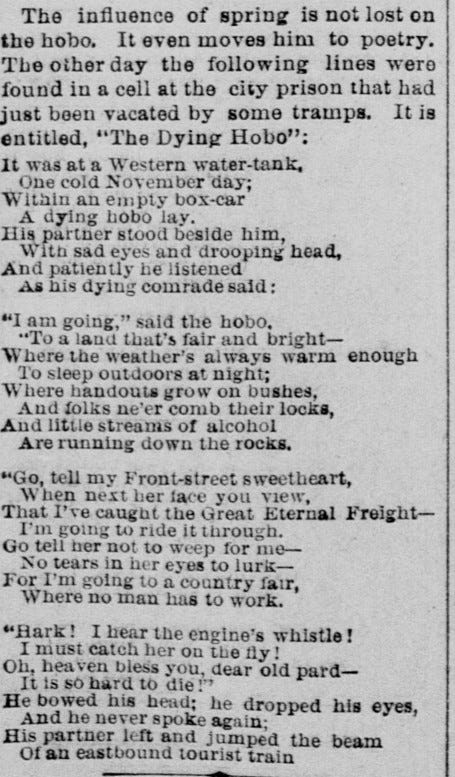
Subject: ADD: A Hobo Poet (1895) From: Joe Offer Date: 29 Jan 20 - 04:57 AM The influence of spring is not lost on the hobo. It even moves him to poetry. The other day the following lines were found in a cell at the city prison that had just been vacated by some tramps. It is entitled, “The Dying Hobo”: It was at a Western water-tank, One cold November day; Within an empty box-car A dying hobo lay. His partner stood beside him, With sad eyes and drooping head, And patiently he listened As his dying comrade said: “I am going,” said the hobo, To a land that’s fair and bright— Where the weather’s always warm enough To sleep outdoors at night; Where handouts grow on bushes, And folks ne’er comb their locks, And littLe streams of alcohol Are running down the rocks. “Go, tell my Front-street sweetheart, When next her face you view, That I’ve caught the Great Eternal Freight— I’m going to ride it through. Go tell her not to weep for me— No tears in her eyes to lurk— For I’m going to a country fair, Where no man has to work. “Hark! I bear the engine’s whistle! I must catch her on the fly! Oh, heaven bless you, dear old pard— It is so hard to die!” He bowed his head; he dropped his eyes, And he never spoke again; His partner left and jumped the beam Of an eastbound tourist train https://miro.medium.com/max/455/1*avIEUkSiWTAikVuiCHOBoA.jpeg “A Hobo Poet,” Sacramento Daily Record-Union, May 9, 1895 |
|
Subject: RE: Origins: The Big Rock Candy Mountain(s) From: Joe Offer Date: 29 Jan 20 - 05:00 AM Another interesting piece of research that warrants study: |
|
Subject: RE: Origins: The Big Rock Candy Mountain(s) From: Lighter Date: 29 Jan 20 - 09:51 AM See also my 2018 posts at the "Dying Hobo" thread. I posted the following to the Ballad List some years ago: 1871 _Morning Telegraph_[NYC)] (Aug. 27) 5: The Geysers of California - Boiling, Alum, Sulphur, Ink, and Lemonade Springs . ...Another curious spring is the "Acid," used in treating skin diseases, and which, when sweetened, makes a drinkable lemonade. 1889 _Hutchinson [Kans.] Daily News_ (Oct. 2) 6: New York, Sept. 30. . . . In the vernacular well known among young toughs, High Bridge told his story to a reporter. He said that New York Red had induced young [13-year-old] Morgan to accompany him as a tramp by visionary tales of rock candy mines and lemonade springs. The three set out on foot toward New Haven and walked to Larchmont, where they managed to steal a ride as far as Rye on the front platform of a passenger train. 1896 _Plainfield [Ind.] Reformatory_...Published Weekly at the Plainfield Reformatory for Boys. ...(May 9): I know a young man to-day who went west armed to the teeth to seek his fortune, and to look up the Rockcandy mountains, the Lemonade springs, the Cigarette valley, and a few more such places he had heard of, and he found that it was a failure in the end, and there was no place like home after his trouble. 1899 _Philadelphia Inquirer_ (July 28) 8 [newsboys conversing]: "Where do you think youse'll go when you take a day off? ...I guess I'll go to the Lemonade Springs." ..."Lemonade Springs? Where's them?" "Oh, in the Rock Candy Mountains." ...And the question that is puzzling [my] mind is whether that boy simply picked that phrase up or whether he imagined it and is a poet in embryo. My surmise for now is that the "Lemonade Springs" of California suggested that the Rockies were actually "Rock Candy" mountains. Still looking for the Cigarette Valley though. |
|
Subject: RE: Origins: The Big Rock Candy Mountain(s) From: Joe_F Date: 29 Jan 20 - 05:54 PM Well, we need no longer guess (see my post upthread). The line suppressed by the Lomaxes is "To be buggered sore like a hobo's whore". The damnedest loose ends will get tied up if you wait long enough. |
|
Subject: RE: Origins: The Big Rock Candy Mountain(s) From: Joe Offer Date: 29 Jan 20 - 06:24 PM Jim caught it in his transcription of the 1928 recording - McClintock whistles the "forbidden words." "To be buggered sore like a hobo's whore" fits the space of the missing words, but do we have any documentation of what it really is? -Joe- |
|
Subject: RE: Origins: The Big Rock Candy Mountain(s) From: Joe_F Date: 30 Jan 20 - 06:33 PM It's in the "interesting piece of research" linked to by Joe Offer above. |
|
Subject: RE: Origins: The Big Rock Candy Mountain(s) From: Joe Offer Date: 30 Jan 20 - 11:10 PM Hi, Joe - yes, the interesting piece of research has it, but does not give its source. Another excerpt: BIG ROCK In Hollywood on September 6, 1928, he recorded his most famous song ‘The Big Rock Candy Mountains.’ Postcards with the printed lyrics show that he had composed the song about 1906 by cleaning up an older bawdy song sung by hobos. The original song was about hoboes molesting children along the railroad and in the hobo jungles. The bawdy original has not survived but the words of the last stanza were The punk rolled up his big blue eyes And said to the jocker, “Sandy, I’ve hiked and hiked and wandered too, But I ain’t seen any candy. I’ve hiked and hiked till my feet are sore And I’ll be damned if I hike any more To be buggered sore like a hobo’s whore In the Big Rock Candy Mountains.” One stanza was lifted from an old song called ‘The Dying Hobo.’ |
|
Subject: RE: Origins: The Big Rock Candy Mountain(s) From: GUEST,The Neb Date: 07 Sep 20 - 07:17 PM I believe they hung the *Turk* who invented work, not the jerk (though he may have been that too). |
|
Subject: RE: Origins: The Big Rock Candy Mountain(s) From: GUEST,henryp Date: 08 Sep 20 - 07:25 AM Mark Radcliffe played Harry “Haywire Mac” McClintock singing Big Rock Candy Mountain on the Folk Show just last week. Haywire Mac McClintock also claimed to be the first person to perform The Preacher and the Slave written by Joe Hill, also known as Pie in the Sky, to the tune of In the Sweet By-and-by. He said in an interview with Sam Eskin, recorded in 1951, "You know the ‘Long-haired Preacher Song? Everybody knows that. I had the honor of singing that for the first time in public. Joe brought it in and turned it over to the Secretary of the Portland local of the IWW. He got out a leaflet on it. I think we sold, at the second street meeting — the first street meeting we weren’t prepared, we didn’t have it printed — but the second street meeting we sold over $30 worth of them at a dime a throw or whatever they wanted to contribute." |
|
Subject: RE: Origins: The Big Rock Candy Mountain(s) From: GUEST,Frank Hamilton Date: 08 Sep 20 - 05:32 PM I actually met Mac McClintock when I was a young man. I think the town he lived in was El Segundo near Long Beach California. I believe that's where the Queen Mary is docked. I spent the afternoon with Mac. He told me that he was a railroad "boomer" meaning that he could hop any freight in the country and as a railroad worker not be hassled by the "bulls". He was a delightful person and I remember that we went after our visit to hear a Mexican Tipeca Band play at the local park. My favorite line (having to do with jerk, Turk and work" was the one he sang, "They boiled in oil the inventor of toil". Mac was very popular in Chicago with his own radio show before I met him. He was fairly along in years when I met him. He must have known Joe Hill and another interesting songwriter/publisher Bob Miller who wrote "Rich Man Poor Man" and had a hit with a country song called "There's a Star Spangled Banner Waving Somewhere". I think Mac was like A.P. Carter who took old songs and rewrote them. After all, this is the "folk process" and.this is how a lot of variants get transmitted from their source. I think a folk song is like a rock in a stream which gets polished as the water runs over it. A song gets sung by so many that it has a unique quality to it. They call this "The communal theory of folk music". "Preacher and the Slave" by Joe Hill is "In the Sweet Bye and Bye", an old hymn in the way that "Which Side Are You On" is an old hymn rewritten by Florence Reese based on "Lay the Lily Low". None of Woody Guthrie or Bob Dylan's melodies are completely original. You can trace their sources. But this is the "folk process". In a way, it's a definition of what a folk song is. |
|
Subject: RE: Origins: The Big Rock Candy Mountain(s) From: leeneia Date: 09 Sep 20 - 12:26 PM "He goes on to say (sadly) that some hobos used the story of the fantastic mountain to lure young boys onto the road with them to do work for them "among other things"!" Good luck with that. I sang this song for my niece when she was six, and as soon as she heard the reference to cigarette trees, she jolted in surprise, and then it was obvious that she didn't believe a word of it. If the kids are on to you by age six.... |
|
Subject: RE: Origins: The Big Rock Candy Mountain(s) From: Lighter Date: 18 Aug 23 - 07:34 PM Indianapolis Star (Jan. 31, 1908): "Forty black-faced Indianapolis comedians will entertain at the Marion Club this evening....The following is the program:...song by Tad Shideler, 'Big Rock Candy Mountain.'" Farmer and Mechanic (Raleigh, N.C.) (Sept. 8, 1908): "Lemonade springs where the bluebird sing on the big rock-candy mountain." So by the end of 1908 the song was known in both the Midwest and the Southeast. |
|
Subject: RE: Origins: The Big Rock Candy Mountain(s) From: GUEST,Nick Dow Date: 18 Aug 23 - 08:34 PM I could not wait to hear Burl Ives sing this on the radio, and despite some of the less favourable interpretations, it remains with me as a memory that has matured over the years. The song sums up the feeling that only touring musicians or similar trampers can experience. The desperately lonely feeling of hammering homeward through the night, seeing a house in the distance with the light still on in the bedroom area, with the rest in darkness, and knowing you have hundreds of miles to go until you can rest in your own bed. That feeling can be so bad, that I always stay over with friends after gigs. When I was young, I slept rough in the West Country and first encountered the sadness of the homeless. It never leaves you. It's funny how songs from your childhood can help—just my experience. |
|
Subject: RE: Origins: The Big Rock Candy Mountain(s) From: Lighter Date: 27 Jun 24 - 11:54 AM More tidbits. From the wide-circulation "Boston Globe" (Feb. 11, 1896): "Curley said to me: 'What do you want to hang around these places for? Why don't you brace up and be a man? Travel is what you need; come with me and be a man.' "I said I would think it over. They had filled me up with stories of Rock Candy mountains, Cigarette grove, Sandwich grove, and all such places." From the "Middletown [N.Y.] Argus" (Apr. 23, 1897): "The Port Jervis police...arrested fifteen tramps. Two of them were boys, aged fifteen and sixteen years, who, when arraigned, told a ghost story about having been enticed from their home in Binghamton by a tramp who promised to show them the 'rock candy mountain' and abandoned them in Port Jervis." Allen County Republican-Gazette (Lima, O.) (Oct. 3, 1899): "You would be right in your 'element' if you were here and listening to some of the yarns [American soldiers in the Philippines] are telling about the 'lemonade springs,' cigarette groves, and rock candy mountains over in the Luzon Islands." Just to belabor the obvious, the notion of "Rock Candy Mountains," etc., was genuine hobo folklore that evidently predated the song. In 1896, Harry McClintock was just twelve years old. |
|
Subject: RE: Origins: The Big Rock Candy Mountain(s) From: The Sandman Date: 27 Jun 24 - 02:29 PM I totally agree with Nicks post. |
|
Subject: RE: Origins: The Big Rock Candy Mountain(s) From: Lighter Date: 27 Jun 24 - 05:05 PM "Marshall P. Locke & Charles Tyner" are virtually unknown to the Net (including newspaper databases), and their song seems to be untraceable. Any suggestions? In the light of the early references to big rock-candy mountains, I submit we can't be sure that their composition was anything like McClintock's. Or vice versa. |
|
Subject: RE: Origins: The Big Rock Candy Mountain(s) From: GUEST Date: 26 Feb 26 - 04:56 PM Bend [Ore.] Bulletin (Apr. 10, 1903): "The editor of THE BULLETIN...being slightly indisposed, was unable to favor the company with that soulstirring [sic] ballad, 'The Big Rock Candy Mountain,'for which he was down on the program." Post and Record (Rochester, Minn.) (May 3, 1909): "Lariat Jack [a hobo]...was heard to sing: Show me the bees and the cigaret trees And the soda water fountains The lemonade springs where the bluebird sings And the big rock candy mountains." |
|
Subject: RE: Origins: The Big Rock Candy Mountain(s) From: GUEST Date: 27 Feb 26 - 11:26 AM Wichita Eagle (June 20, 1925), referred to as "the Lure": On a very fine day in the month of May, A burly bum came hiking. He stretched out free ‘neath a big green tree Which was just to his liking. On that vera me day n the month of May A farmer boy come piking. Says the bum to the son, “If you’ll only come, I’ll show you things to your liking. I’ll show you the bees, the cigarette trees, And the soda water fountains; The lemonade springs where the bluebird sings And the big Rock Candy Mountains. On the Gum-drop Heights they give away kites And marbles made of crystal. You can join the band of Dead Shot Dan And wear a sword and pistol. So he sang this song and the kid went along; For six months they did travel. Then the kid came bac on the very same track, This tale he did unravel. I saw no bees, no cigarette trees, No soda water fountains; No lemonade springs where the bluebird sings, No big Rock Candy Mountains. No Gum-drop Heights where they give away kites, No marbles made of crystal; And there’s no such man as Dead Shot Dan, And I wore no sword and pistol. He put me on the stem, and made me beg, He said he was my jocker. If I didn’t give him pie he blacked my eye, And called me an apple-knocker. So I’ve come back home no more to roam, I’ll save my junkerino. You can bet your lid the four track kid Is nobody’s chumperino. "on the stem" = on the street (to beg) "jocker" = tramp "owner" of boy "apple-knocker" = ignorant rustic "junk" = money "-erino" (nonsense suffix) Quad-City Times (Davenport, Ia.) (March 8, 1925), p. 4, no title, and clearly fragmentary: CELL-HOUSE SONNETS Near the lemonade spring Where the blubeirds sing In the big, rock-candy mountain. There are birds, and bees, and cigarette trees, In the big, rock-candy mountain. A bo went strolling by And I asked him was he dry, Then you oughta heard the Hoosier holler, “To hell with you, and your lemonade too, In the big, rock-candy mountain. "Hoosier" = usually a native of Indiana, but among hobos an ignorant rustic. "It is believed that the fantastic verse about the big, rock-candy mountain, written on the wall of one of the cell [sic] was penciled there by a wanderer moved to strange thoughts while under the influence of a drug. It is safe to assume that a 'snowbird' or a 'hophead' in a moment of delusion and ecstacy [sic] caused by a drug habit might have composed this verse." |
|
Subject: RE: Origins: The Big Rock Candy Mountain(s) From: Lighter Date: 27 Feb 26 - 11:56 AM That was me. More early refs.: Chester [Pa.] Times (Dec. 15, 1904): A ROCK CANDY MOUNTAIN Dear Santa Claus: I want a rattle a doll baby and what ever you do take me to rock candy Mountain and lemonade springs. My name is Willie Irwin 110 East 3d street, Chester, Pa. Owhyhee Nugget (Silver City, Ida.) (March 3, 1910): “This is the kind of weather that makes a person feel like singing tat well known and famous old song: ‘Oh, the birds and the bees and the cigarette trees and the old Rock Candy [sic] mountain,’ etc.” Detroit News (June 18, 1911): “They resemble a hobo’s dream of the Rock Candy Mountain on a frosty morning.” Coconino Sun (Flagstaff, Ariz.) (Oct. 10, 1911): “Joe Barr of Rock Candy Mountain near Seligman has been annoying his friends here for several days past.” McClintock’s recording of “The Big Rock Candy Mountain” was released in 1928. |
|
Subject: RE: Origins: The Big Rock Candy Mountain(s) From: Lighter Date: 27 Feb 26 - 03:55 PM It would seem that the song may have been circulated on the variety stage: The Billboard (NYC) (Dec. 28, 1918): "George A. Clark, the featured comique, and his side pal Harry Seheppell, were in the hobo class and typical of the tribe that flop under the cigarette trees up on Rock Candy Mountain on the shores of Lake Lemonade." The Library of Congress lists a copyright entry for "That big rock-candy mountain, words and music by Billy Mack...Dec. 10, 1928." "Big rock candy mountain" was copyrighted by H. L. McMurray of Miami Beach on May 11, 1931. The Daly City [Calif.] Record (Sept. 21, 1934), referring to 1909: "Colma Valley had many interesting characters, and 'The Bear' (that was the only name we ever knew) was noted for his fog-horn voice that would make any ordinary fog horn blast sound like a whisper. 'The Bear' was also noted for truthfulness, and no one doubted the story of hi island a few leagues west of the Farallones, where he said there was a rock candy mountain from which rivers flowed pure whisky. The only way to reach this island was with a balloon, which accounts for the idea of some skeptics that the story was hot air." The Electrical Workers Journal (Feb., 1938), calls "The Rock Candy Mountain" "an old lineman's classic," but it doesn't say how old. |
|
Subject: RE: Origins: The Big Rock Candy Mountain(s) From: Lighter Date: 27 Feb 26 - 04:38 PM I'm still unable to discover any text or image of Locke & Tyner's "The Big Rock Candy Mountains," copyrighted with the Library of Congress on Dec. 3, 1906. It may be that one of the two or three non-McClintock versions published in songbooks of the '40s and '50s is the Locke & Tyner song. |
|
Subject: RE: Origins: The Big Rock Candy Mountain(s) From: Lighter Date: 27 Feb 26 - 06:46 PM Well, well, and again well. It look like AI ain't that bad. My artificial buddy Claude led me, eventually and with appropriate skepticism and not a little luck, to an article by Colin Johnson called "Casual Sex," all about - wait for it - hobo [sic] sexuality, in an academic tome entitled "Subaltern Citizens and Their Histories," ed. by Gyanandra Pandey (2010). Johnson appears to have unearthed from the L. of C. the 1906 lyrics. Here they are. I've improved only the spacing and added some commas and periods periods for readability: On a very fine day in the month of May, A burly bum he went out a hikin’; On the very same day in the month of May A farmer’s son was a pikin’; Said the bum to the son Won’t you come, oh, come to the big Rock Candy Mountains, And I’ll show you the bees and the cigarette trees And the soda water fountains. Where the blue bird sings, ‘round the chicken soup springs, And the soda water flows from the fountains, And I’ll show you the bees and the cigarette trees, In the big Rock Candy Mountains. Said the son to the bum, for a farmer’s son, It’s the sporty place to be a goin'. If the cigarette trees wave in the breeze Without the need of a hoe-in’. So before it’s dark let us make a start For the big Rock Candy Mountains, And the place that you know, where the cigarettes grow, By the ice-cream soda fountains. Where the blue bird sings, ‘round the chicken soup springs, And the soda water flows from the fountains, From the cigarette trees smoke all we please, In the big Rock Candy Mountains. So the very same day in the month of May The bum and the son they went a hikin,’ And the farmer’s son was a havin fun, At the purty gals was a pikin’. Said the bum to the son, there’ll be lots of fun, As the mile posts they were counting, For the girls all wear white stockings, I declare, In the big Rock Candy Mountains. Where the blue bird sings, ‘round the chicken soup springs, And the soda water flows from the fountains, And the girls we’ll squeeze by the cigarette trees, In the big Rock Candy Mountains. On the very same night, in a loud delight, The farmer’s son he lay a snorin’ On a side-tracked train to the same refrain The while the bum was a scorin’. Good bye there’ll be fun for the farmer’s son, When you wake at Bell-a-Fountain, For your clothes and your shoes, I will drink up in booze, While you dream of Candy Mountains. Where the blue bird sings, ‘round the chicken soup springs, And the soda water flows from the fountains, That’s the end of the son and the rummy-dum dum And the big Rock Candy Mountains. "Piking" = seeing, looking "Rumdum" = a drunken tramp, a "rummy." Unfortunately Johnson doesn't say explicitly that the published tune was the familiar one. Locke-Tyner and McClintock bear obvious resemblances, but they likely both derive from a common source, perhaps only in fragments. Cf. also the 1925 Wichita Eagle text and Gordon's very similar but sexually explicit (in a line ir two) "Appleknocker's Lament" (collected in 1927). |

| Share Thread: |
| Subject: | Help |
| From: | |
| Preview Automatic Linebreaks Make a link ("blue clicky") | |